
NAP Consistency: A Local SEO Guide for Multi-Location Clinics
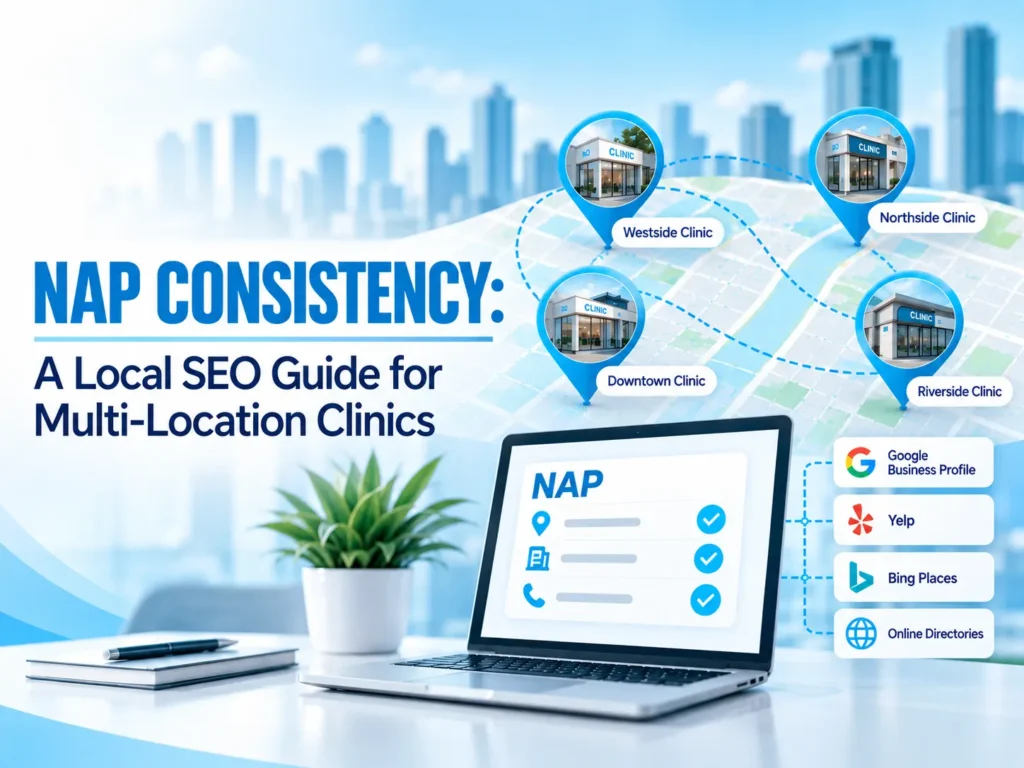
Quick Summary NAP consistency means your clinic name, address, and phone number match exactly across every online platform. A single mismatch in your NAP consistency SEO signals sends conflicting data to Google, which drops your local pack rankings. Multi-location clinic SEO is especially at risk because each branch creates its own citation footprint that can drift over time. Fixing NAP citations for healthcare businesses requires a structured audit across all directories, not just Google. The best tools to audit NAP consistency for clinics include BrightLocal, Semrush Listing Management, and Whitespark. A clean NAP consistency local SEO foundation is now also a requirement for appearing in Google AI Overview answers in 2026. You could have the best dental or beauty clinic in your city, a five-star reputation, and a well-designed website, and still be invisible on Google Maps. The reason is almost always something patients and clinic owners never think about. It is NAP consistency. Your clinic name, address, and phone number are either identical everywhere Google looks, or they are not. When they are not, Google stops trusting your business data and quietly removes you from the local pack. For local SEO for multi-location clinics, this problem multiplies with every new branch you open. Each location creates its own citation footprint across dozens of directories. One old phone number left on a listing from two years ago is enough to suppress an entire location from ranking. This guide walks through exactly what NAP consistency means in 2026, why it damages rankings faster than most SEO mistakes, and the step-by-step process to fix it permanently. What Is NAP Consistency in SEO and Why Google Cares in 2026 NAP consistency in SEO refers to having your business name, address, and phone number listed in exactly the same format on every platform where your clinic appears. That includes your Google Business Profile, Yelp, Healthgrades, Justdial, Practo, your own website, local directories, and any other citation source. Google uses your NAP data as a trust signal. It crawls many directories and finds matching information. This confirms that your business is real, active, and accurately represented. When it finds mismatches, it cannot determine which version is correct, so it lowers your confidence score and pulls you down in local search ranking factors. In 2026, this matters even more because Google AI Overviews now pull clinic data from structured sources. A business with inconsistent NAP is far less likely to be cited in an AI-generated answer because the data cannot be verified with confidence. 2026 Data Point: Google’s local search guidelines say that accurate business listings are key for local pack eligibility. This is one of three main signals, along with proximity and prominence. Inconsistent NAP hurts listing accuracy. This is the signal clinics often get wrong. How NAP Inconsistency Hurts Local SEO Rankings for Clinics 1. Trust Score Drops Every time Google finds a different version of your clinic name, address, or phone number across the web, it subtracts from what can be described as your local trust score. This is not a visible metric, but it directly affects your local pack rankings. A clinic listed as “Bright Smile Dental” on Google but “Bright Smile Dental Clinic” on Healthgrades and “BSM Dental” on Justdial is giving Google three different identities. Google cannot reconcile them into one authoritative listing, so it ranks all three versions lower than a competitor with a single, clean identity. 2. Maps Pack Removal The Google Maps pack shows the top three local results for any clinic-related search. Getting into that pack is the primary goal of NAP consistency in local SEO. Many clinic owners don’t realize that a listing can lose its rank completely. This can happen after a location change, phone number update, or rebrand. If old information isn’t fixed across citation sources, it can hurt visibility. The old listing pulls in one direction. The new one pulls in another. Google resolves that conflict by ranking neither of them confidently. 3. AI Overview Exclusion In 2026, why AI search engines skip inconsistent businesses is a real and growing problem. Google’s AI Overviews pull data from structured sources and cross-reference it. A clinic with conflicting NAP data across directories does not meet the verification threshold Google’s AI uses before citing a business as a local recommendation. Fixing NAP is now a prerequisite for AI visibility, not just Maps pack visibility. “One typo that is costing your clinic new patients could be as simple as a missing suite number or a phone number with the wrong area code on a single directory. That one mismatch is enough for Google to question the accuracy of your entire listing.” The NAP Consistency Checklist for Healthcare Businesses With Multiple Locations This is the NAP consistency checklist for healthcare businesses that multi-location clinics should run every quarter. Each item directly affects how Google reads and ranks your location data. Checklist Item What to Verify Business Name Format Identical across GBP, Yelp, Healthgrades, Practo, Justdial, and your website Address Format Same abbreviations, suite format, and pin code on every platform Phone Number One primary number per location, consistent format with country code where needed Google Business Profile Each location has its own separate verified GBP listing. Website Location Pages Each branch has a unique landing page with matching NAP in the footer and schema. Schema Markup The local business schema on each location page includes exact NAP matching GBP Old Listings Previous addresses or numbers removed or updated across all directories Citation Sources Top 20 directories audited and corrected for each clinic branch How to Fix NAP Inconsistency for Multiple Clinic Locations Knowing how to fix NAP inconsistency for multiple clinic locations starts with one non-negotiable step. You must audit before you build. Many clinics mistakenly create new listings to replace inconsistent ones. This only doubles the problem instead of solving it. 1. Run a Full Audit First Before changing anything, search your clinic name and each branch address across Google, Yelp, Healthgrades, Justdial, Practo, and
Clinic Marketing: Right Way to Ask Patients for Google Reviews
You just had a great appointment. The patient left happy, your team did everything right, and that person is almost certainly going to tell a friend. But they will never leave a Google review unless you ask. That is the gap most clinics are sitting in right now. Knowing how to ask patients for Google reviews is one of the highest-return clinic marketing moves a clinic can make in 2026. Google’s local search algorithm weighs review volume and recency heavily, and Google AI Mode now surfaces clinic cards with review summaries directly in search answers. If you are not in those results, a competitor is. This guide shows you the exact methods, timing, and scripts to fix that. You’ll do it without feeling awkward, crossing ethical lines, or violating patient privacy. Why Google Reviews for Medical Practice Matter More Than Ever in 2026 In 2026, online reputation for doctors is no longer a bonus. It is a baseline requirement. Google AI Mode generates direct answers to patient queries like “best dentist near me” by pulling from review data, structured content, and trust signals. Clinics with fewer than 30 reviews are being skipped in AI-generated recommendations entirely. Here is why Google reviews matter for your clinic marketing – the numbers break it down: Here is the exact table based on the data you provided: Review Count Google Map Pack Visibility AI Overview Inclusion Patient Trust Impact 0 to 10 Very low Excluded Significant doubt 10 to 30 Moderate Rarely included Mild trust 30 to 75 High Often included Strong credibility 75 plus Dominant Consistently featured Top patient choice The math is simple. More consistent medical practice online reviews equal more visibility, more appointments, and faster clinic growth. Good Clinic marketing brings good traffic. Can Doctors Ask Patients for Google Reviews? What the Rules Say Yes, doctors and clinic owners absolutely can ask patients to leave reviews. There is nothing unethical about it as long as you follow the right boundaries. The question is how, not whether. Is it ethical to ask patients to leave reviews? Yes, as long as you don’t offer incentives for reviews, which breaks Google policy and medical ethics. Also, avoid pressuring patients and discussing specific clinical outcomes that reveal protected health information. A clean, HIPAA-compliant review request never mentions a patient’s condition, treatment, or visit details. You are asking them to share their overall experience with your clinic, not their medical history. As long as the review request does not reference protected health information (PHI), you are safe. Quick rule: Ask patients to review the experience of visiting your clinic, not the outcome of their treatment. “Tell others about your visit” is safe. “Tell others how your filling went” is not. clinic marketing is all about reviews. How to Ask Patients for Google Reviews: The Three-Channel Method The best way to ask patients to leave a Google review is through a consistent three-channel system, not a one-time ask. This is what top clinics use for review generation in healthcare. Channel 1: The In-Person Ask at Checkout The checkout moment is the highest-intent window you have. The patient is still emotionally engaged with the positive experience. Train your front desk to make this a habit, not an afterthought. Script to ask patients for a Google review (In-Person) “It was wonderful having you in today. If you have two minutes later, we would really appreciate a Google review. It helps other people in [City] find us. I can send you the link right now if you like.” Hand them a printed QR code card or text them the direct Google review link on the spot. Reduce friction to zero. Channel 2: The SMS Follow-Up Within 2 Hours This is the highest-converting post-visit follow-up message method in 2026. SMS open rates sit at over 90 percent. Send the message within two hours of the appointment while the experience is fresh. SMS Script (Keep it under 160 characters) “Hi [First Name], thank you for visiting [Clinic Name] today. We hope you feel great! Would you mind sharing your experience on Google? [Direct Review Link]” Channel 3: The Email Follow-Up Within 24 Hours Not every patient will respond to SMS. A well-timed email is your second touchpoint. Keep it short, personal, and direct. One clear call to action, no clutter. Email Script Subject: Quick favour from [Clinic Name] Hi [First Name], thank you for choosing us today. If you had a good experience, we would love for you to share it on Google. It takes less than two minutes and helps patients like you find us. [Leave a Review Button] Warm regards, [Doctor Name / Team Name] When to Ask Patients for Google Reviews After an Appointment When to ask patients for Google reviews after an appointment matters as much as how you ask. Timing is the most overlooked part of any patient feedback strategy. 0 to 2 hours post-visit: Best time for SMS. Emotions are high, and memory is sharp. Same day, evening: Best time for email. Patient is settled and more likely to act. 24 to 48 hours: Acceptable for a single follow-up reminder if they have not responded yet. Beyond 72 hours: Conversion drops sharply. Do not push a third ask. The single biggest mistake doctors make when asking for reviews is waiting too long or not asking at all because it feels uncomfortable. Time kills intent. A patient who felt great during the appointment will feel neutral about it three days later. How to Politely Ask a Patient for an Online Review Without Pressure Knowing how to politely ask a patient for an online review is about tone and framing. Never use language that implies obligation. The word “would you mind” consistently outperforms “please leave us” in response tests because it feels like a request, not a demand. Here are the framing principles that work: Lead with gratitude before the ask Mention the benefit to other patients, not to your business Give them one clear, single-tap link
Digital Marketing Agency for Healthcare Clinics: What to Look For in 2026

Quick Summary Choosing the right digital marketing agency for healthcare clinics in 2026 means looking beyond follower counts and ad budgets. Google AI Mode now surfaces only authoritative, structured content, making clinic-specific SEO non-negotiable. Digital marketing for clinics must balance patient trust, local visibility, and HIPAA-aware advertising standards. Generalist agencies miss the nuance of patient behavior, treatment-specific landing pages, and healthcare compliance. The best agencies combine local SEO, paid ads, reputation management, and content that answers real patient questions. Marketing for clinics that is data-driven, transparent, and consistently optimized delivers compounding patient growth over time. Why Most Clinics Choose the Wrong Digital Marketing Agency for Healthcare Clinics Most clinic owners make the same mistake. They hire an agency based on a polished pitch deck, a low monthly retainer, or a promise of a hundred leads in thirty days. Six months later, the leads are useless, the Google rankings haven’t changed, and the ad spend is wasted with no results. The healthcare space is different from e-commerce or real estate. Patients are making decisions about their bodies and their health. They research thoroughly, read reviews carefully, and choose based on trust before price. A digital marketing agency for healthcare clinics that doesn’t understand this dynamic will run generic campaigns. As a result, they will attract unqualified clicks and miss out on the patients who actually book appointments. In 2026, the bar is higher. Google’s AI search now rewards clinics with structured, authoritative content. Patients use voice search and AI assistants to ask complex questions even before visiting a website. Compliance matters more than ever; advertisers working with patient data should stay grounded in HHS guidance on HIPAA and marketing. The agency you pick must be designed for this environment, not just adapted from a general marketing guide. What Clinic-Specific Experience Looks Like in a Healthcare Marketing Agency Real experience in healthcare marketing shows up in how an agency works day to day, not just what they list on their website. 1. Patient Psychology Mastery A clinic-focused agency knows that a patient researching complex procedures like dental implants rarely books immediately. They are evaluating safety, cost, and reputation. Campaigns mapped to this research phase convert far better than aggressive, direct-response ads pushing cold audiences for an immediate booking. 2. Strategic Channel Matching Search engines excel at capturing high-intent inquiries like emergency dentistry or specific orthodontic treatments. Conversely, social media platforms drive awareness for cosmetic services like teeth whitening. Top-tier agencies move away from one-size-fits-all strategies. They match specific treatments to the exact platforms where patients search for them. 3. Niche Case Studies True expertise requires verifiable proof. A qualified agency offers clear, measurable results from dental, beauty, or medical practices. It’s not just generic e-commerce metrics dressed up as a healthcare experience. Look for clear data on increased appointment volume, reduced acquisition costs, and dominant local search rankings. 4. AI Search Optimization Ranking on traditional search pages is no longer the final goal. Modern search engines use AI to gather answers from reliable sources. These answers appear above regular listings. Skilled teams enhance your treatment guides, FAQ sections, and website layout to ensure key AI citations. What Services Should a Digital Marketing Agency for Healthcare Clinics Offer? Not every agency offering marketing for clinics provides the right combination of services. Here is what a complete healthcare marketing setup requires in 2026: Service Why It Matters for Clinics Local SEO and Google Business Profile Drives map pack rankings and direct appointment bookings Google Ads Management Captures high-intent patients actively searching for treatments Meta Ads Builds awareness for cosmetic and elective procedures Reputation Management Automates review generation and protects online credibility Landing Page Optimisation Converts ad traffic into booked appointments Content and Blog Strategy Builds topical authority for AI and organic search Reporting and Analytics Tracks real outcomes like leads, cost per acquisition, and ROI A digital marketing agency for healthcare clinics that offers only two or three of these services will create gaps in your patient acquisition system. Patients move across channels before booking.and strong conversion depends on where that traffic actually lands – see how we structure specific strategies built to convert clinic ad traffic Your marketing needs to cover the full journey. How to Evaluate Transparency and Reporting Before You Sign Anything One of the clearest signs of a trustworthy digital marketing agency for healthcare clinics is how they talk about results before the contract is signed. Be cautious of any agency that: Promises a specific number of leads in the first month without auditing your current setup Cannot explain clearly how they measure cost per acquisition Offers reporting only once per month with no live dashboard access Mixes vanity metrics like impressions and clicks without tying them to booked appointments The right agency will show you what they track, how they report it, and what a realistic growth curve looks like for your market, competition, and budget. Digital marketing for clinics, based on transparency, keeps owners informed and in control of their investment. The Right Questions to Ask a Digital Marketing Agency for Healthcare Clinics Before committing to any agency, ask these questions directly and listen carefully to how they respond: How many dental or medical clinic clients are you currently managing? Can you show us the before-and-after metrics from a clinic in a similar market? How do you structure campaigns to appear in Google AI overviews? What does your reporting dashboard look like, and how often will we meet to review it? How do you handle negative reviews and reputation management for clinic clients? What is your process for building treatment-specific landing pages? How do you ensure our ads and content stay compliant with healthcare advertising standards? An agency that gives clear, confident answers with real examples deserves another chat. An agency that deflects questions, over-promises results, or gives vague answers about strategy risks your marketing budget and your clinic’s growth. Why Marketing A Clinic Is Built Specifically for This Marketing A Clinic is not a generalist agency
How Digital Marketing for Clinics Helps to Get More Patients
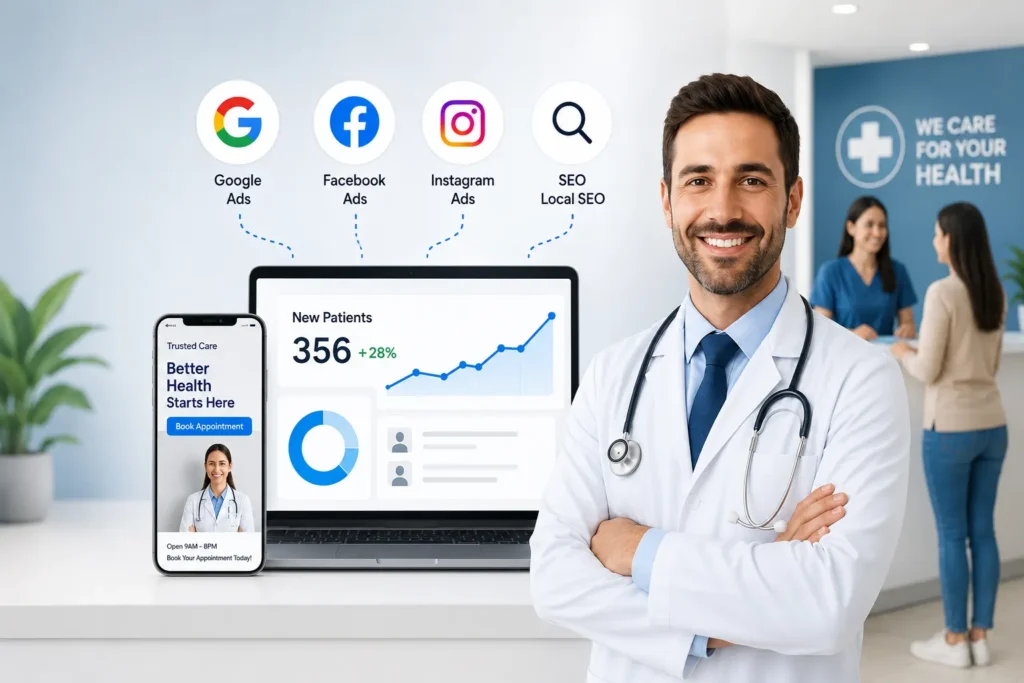
Quick Summary Digital Marketing for Clinics helps practices establish authority, maintain visibility, and adapt to modern patient search behaviors. Local marketing for clinics using Google Business Profile and NAP consistency drives foot traffic. Healthcare SEO services help clinics rank on Google’s first page and appear in AI Overviews. Online patient booking strategies reduce no-shows and increase daily appointment volume. Clinic growth strategies combine SEO, paid ads, and content to build a steady patient pipeline. Integrating smart, user-friendly online patient booking strategies removes friction and converts website visitors into confirmed appointments. Many clinic owners focus on improving their skills for years. However, they often neglect to ensure that patients can find them online. That is the gap digital marketing for clinics fills. Whether you run a dental practice, a beauty clinic, or a wellness center, your patients are searching Google before they ever call you. If your clinic is not showing up, a competitor is getting that appointment instead. This guide explains how digital marketing for clinics works in 2026. It covers effective strategies that make a difference and shows you how to attract more patients without overspending. So, let’s discuss without getting delayed! What Is Digital Marketing for Clinics and Why Does It Matter in 2026? Digital marketing for clinics means using online channels. This includes search engines, paid ads, social media, and your website. The goal is to connect with people searching for healthcare or aesthetic services nearby. In 2026, Google’s AI search will show answers in the AI Overview panel. This means well-optimized clinics can appear at the top, before traditional organic results even start. Traditional Route AI & SEO Casual Word of Mouth Search Generative Overviews Random Drive-by Visibility Local Maps Packages Phone Book Directories Verified Patient Reviews Untracked Print Flyers Instant One-Click Booking Why clinics need digital marketing has never been clearer. More than 77% of patients in India and worldwide use search engines to find local healthcare providers before booking. If your clinic’s name, address, and phone number differ in directories, Google won’t trust your business. This means it won’t show your clinic prominently. How Local SEO Helps Clinics Attract Nearby Patients Local marketing for clinics begins with the basics. First, optimize your Google Business Profile. Next, ensure your NAP (Name, Address, Phone) is consistent. Finally, maintain accurate local citations on platforms like Google Maps for dental and beauty practices. 1. Google Business Profile Optimization Your Google Business Profile is the single most powerful free tool available to any clinic. An optimized profile with current hours, service categories, photos, and real patient reviews increases your chances of appearing in the local three-pack. This three-pack includes the map results that lead mobile searches. 2. NAP Consistency Across Directories Google cross-references your clinic’s information across dozens of online directories. Even a small inconsistency like a shortened street name or an old phone number can suppress your local rankings. Audit every listing at least once a quarter. 3. Building Local Citations Local citations for dental and beauty clinics on well-known US directories such as Yelp, Healthgrades, and Zocdoc tell Google that your business is legitimate and locally relevant. Each citation acts as a trust vote. 4. Targeting the Right Local Keywords Phrases like “dental clinic near me,” “best skin clinic in Forest Hills,” and “hair growth treatment Baltic” carry high commercial intent. Optimizing your pages and Google Business Profile for these terms is the fastest route to local visibility. Best SEO Strategy for Clinics to Rank on Google and AI Overview Healthcare SEO services in 2026 operate in an environment shaped heavily by Google’s E-E-A-T (Experience, Expertise, Authoritativeness, and Trustworthiness) framework and the rise of AI Overviews. Here is what the best SEO strategy for clinics looks like today. 1. On-Page SEO That Answers Patient Questions Google’s AI surfaces content that directly and concisely answers a question. Organise your service pages and blog posts with: Clear headings Short paragraphs Bullet points This helps the AI easily extract and cite your content. 2. Building Authority Through Content Publishing regular educational content such as treatment guides, procedure FAQs, and patient case studies positions your clinic as an expert. This is how smaller clinics compete with larger hospital brands without spending a fortune on ads. 3. Technical SEO Foundations Page speed, mobile-friendliness, structured data (Schema markup for clinics), and secure HTTPS are non-negotiable. Google’s ranking systems in 2026 penalise slow and unoptimised sites even when the content is good. 4. Healthcare PPC Campaigns as an SEO Complement While healthcare PPC campaigns through Google Ads deliver immediate traffic, they work best when paired with organic SEO. Paid ads show you which keywords work and which services draw inquiries. You can use this data to improve your organic strategy. Online Patient Booking Strategies That Actually Fill Your Calendar Getting traffic to your website means nothing if visitors do not convert into appointments. Online patient booking strategies connect curious visitors to confirmed patients. Online appointment booking software, added directly to your website or landing page, makes things easier. Patients should be able to select a service, choose a time slot, and confirm a booking in under two minutes. Here is what the highest-converting clinic websites do differently: Strategy Impact One-click booking button above the fold Up to 35% lift in conversion rate WhatsApp chat widget for quick queries Reduces bounce and builds trust Patient testimonials near the CTA Increases form submissions by 20-30% Mobile-first design Critical-over 70% of clinic searches happen on mobile Clear service pricing or “starting from” anchor Reduces hesitation and price-related drop-offs Automated appointment reminders through SMS or WhatsApp cut down no-shows. This boosts your revenue without needing to get any new patients. Best Digital Marketing Strategies for Clinics: A Practical Checklist A digital marketing checklist for clinics keeps your efforts structured and measurable. Use this as your operational guide. 1. Foundational (Month 1) Claim and fully optimise your Google Business Profile Audit and fix NAP consistency across all directories Ensure your website is mobile-optimised and loads in under three
Digital Marketing for Clinics: Complete Guide for 2026

Quick Summary Digital marketing for clinics in 2026 is built on three pillars: local SEO, AI search visibility, and conversion-first content that turns website visitors into booked appointments. Local SEO for dental clinics and local SEO for beauty clinics now depend on Google Business Profile signals more than any other ranking factor for “near me” searches. To get Google AI Mode visibility, clinics should structure each page with direct answers. Use FAQ schema and E-E-A-T signals, but avoid keyword-stuffed paragraphs. Healthcare digital ad spend is projected to hit $26.2 billion in 2026 (Statista), meaning competition for patient attention has never been more expensive or competitive. The best digital marketing strategies for clinics mix organic local SEO with targeted paid ads and reputation management. If you run these separately, you lose ROI. A digital marketing agency focused on healthcare clinics does better than generalist ones. This is because it understands patient trust, local search intent, and how clinics convert patients. These areas need specialized knowledge. In 2026, patients no longer browse websites; they ask AI engines for immediate doctor recommendations. If your practice isn’t the top answer, you are invisible. Mastering Digital Marketing for Clinics is your only way to survive. Traditional advertising is officially dead in India’s healthcare sector. Patients demand instant, credible answers via conversational search tools. Embracing modern marketing for clinics is now the ultimate metric separating thriving practices from completely empty waiting rooms. To dominate your local market, you must adapt to zero-click searches and AI overviews. Implementing the best digital marketing strategies for clinics will immediately position your healthcare brand as the most trusted local authority. What Is Digital Marketing for Clinics and Why Does It Matter Right Now? Digital marketing for clinics uses online channels like search engines, paid ads, social media, and content. This helps attract new patients, build trust, and keep appointment books full. It is not about being everywhere online. It is about being in the exact place a high-intent patient is looking at the exact moment they are ready to act. The Market Reality in 2026 According to Statista, healthcare and pharma digital ad spend is projected to reach $26.2 billion in 2026, up from $19.6 billion in 2024. Your competitors are investing hard in digital. Staying passive is not a neutral decision-it is a losing one. Why the Numbers Demand Action 82% of patients research a provider online before making any contact 94% of patients read online reviews before choosing a clinic 40% of all health queries are now answered directly inside Google AI Overviews (Statista, 2026) “Near me” healthcare searches have more than doubled since 2015 If your clinic’s online presence doesn’t answer questions, build trust, or make booking easy, you’re losing patients to competitors who do. How Does Digital Marketing Help Clinics Get More Patients? Digital marketing helps beauty and dental clinics attract modern patients by significantly expanding online visibility. It ensures your services appear instantly when local individuals actively search for nearby healthcare solutions, treatment reviews, or specialized doctors. Local SEO Boosts: Optimizing your Google Business Profile places your clinic directly into local map results, capturing high-intent searches. Targeted Paid Advertising: Google and Meta ads place your high-margin treatments directly in front of specific local demographics. Frictionless Online Booking: Embedding automated appointment software directly onto your service pages converts casual website visitors into confirmed patients. Reputation Management Systems: Showcasing verified five-star patient reviews and testimonials builds immense trust before a patient ever calls. By tracking these digital touchpoints, your clinic can completely stop guessing which marketing campaigns work. You gain clear data showing exactly how many clicks turn into real, revenue-generating calendar bookings. How Multi-Channel Digital Marketing Drives Clinic Growth SEO and digital marketing for clinics create long-term compounding visibility that costs less per visit over time. Running it alongside paid creates a feedback loop where organic credibility makes ads convert better and ads accelerate what SEO is building. Google Business Profile optimization wins the local map pack, which sits above every organic result and drives the majority of clinic phone calls Healthcare PPC campaigns deliver immediate leads for high-margin treatments like Invisalign, lip fillers, or teeth whitening Online appointment booking on every service page removes the friction that kills conversions between a click and a confirmed visit NAP consistency across every directory signals location accuracy to Google’s local algorithm Run these together and the outcome is predictable growth. Run them in isolation and you get results that are impossible to diagnose. Why Clinics Need Digital Marketing: The 2026 Patient Has Changed The 2026 patient does not call first. They search, read reviews, visit your site on mobile, check if booking is easy, and then decide all before a single conversation with your front desk. How Patient Behavior Has Shifted Statista reports that spending on digital ads in healthcare and pharma has surpassed TV ad spending. Now, it makes up the largest portion of total healthcare advertising. That shift tracks exactly with how patients now make decisions: Patients who booked appointments ran 3x more searches than those who did not (Google) 72% trust only clinics with a 4-star rating or above Almost half of patients are willing to go outside their insurance network for a provider with strong online reviews What This Means for Your Clinic Why clinics need digital marketing is simply this: patients now behave like consumers. They compare, validate, and choose based on what they find online before they ever call. The clinics winning in 2026 are not necessarily the best clinicians in their city. They are the most visible, most trusted, and easiest to book. Digital marketing closes that gap between clinical quality and patient acquisition. How Local SEO Helps Clinics Dominate Neighbourhood Search Local SEO for clinics helps to go from low visibility to a packed appointment calendar. Plus, it costs much less than paid ads after the foundation is set. Local SEO for Dental Clinics Local SEO for dental clinics starts with owning the Google map pack for every high-intent