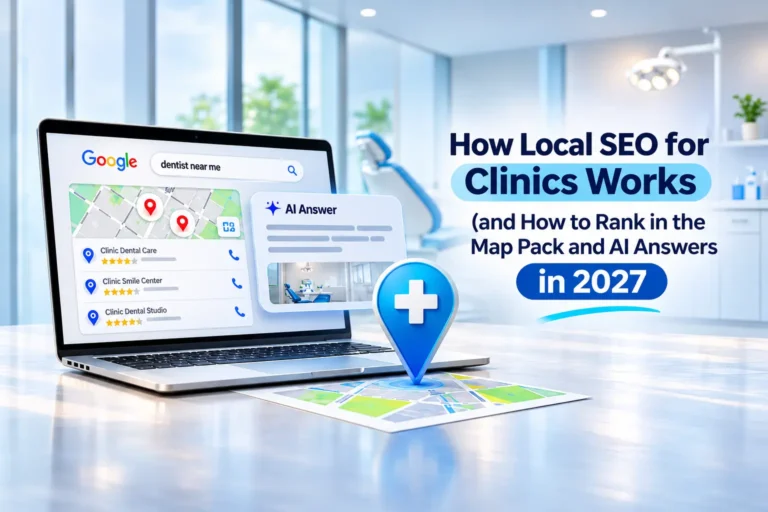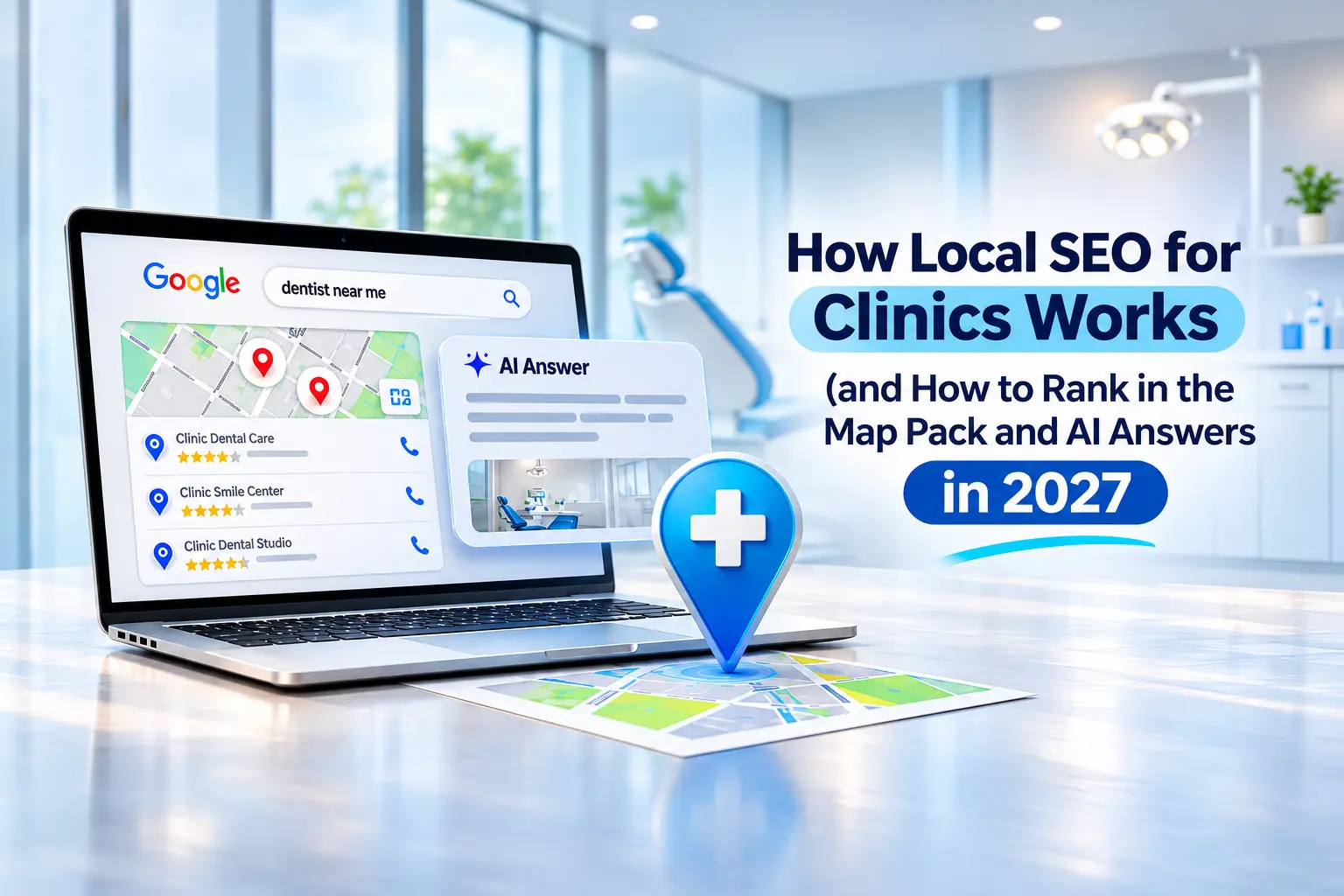
How Local SEO for Clinics Works (and How to Rank in the Map Pack and AI Answers in 2027)
What This Guide Covers
- Why local SEO for clinics drives more patient bookings than paid ads in 2027
- How to rank your clinic on Google Maps using the three signals Google actually measures
- Google Business Profile optimization steps that move you into the local pack fast
- How to get more Google reviews for your clinic and why review velocity beats total count
- NAP citations consistency and why one mismatch across directories quietly kills your ranking
- How AI Overviews are changing clinic digital marketing services and what to do about it now
Local SEO for clinics is the single most cost-effective patient acquisition channel available to a healthcare practice in 2027. Not paid ads. Not social media. When a patient searches “dental clinic near me” or “skin clinic open today,” they are ready to book right now. Local SEO is what decides whether your name shows up or your competitor’s does.
The numbers back this up. 76% of people who perform a local search on a smartphone visit a business within a day, and 28% of those searches result in a booking or purchase. These are not people browsing. They are patients with intent. Local SEO puts your clinic directly in front of them at the exact moment they decide to act.
This guide explains every signal that boosts your clinic’s Google Maps ranking in 2027. It highlights what many clinics get wrong and details the actions that yield real results in 30 to 90 days.
How Local SEO for Clinics Works and Why It Is Different from Regular SEO
Regular SEO is about ranking your website pages for informational searches. Local SEO for clinics is about ranking your Google Business Profile for high-intent, location-based searches. The two overlap, but they serve different patient moments.
Google uses three main factors to rank businesses in Google Maps results. Relevance is how well your clinic matches what someone is searching for. Distance is how close your clinic is to the person searching. Prominence is how well-known and trusted your clinic appears across the web. Distance is the only one you cannot influence. Relevance and prominence are where your clinic’s marketing effort goes.
How it is different from Regular SEO:
Healthcare is also treated differently by Google than other industries. Google treats health topics as sensitive because poor information can affect a person’s safety, finances, or life decisions. This means your clinic’s content needs to meet a higher standard of accuracy and trust to rank well. Thin, vague, or generic content will not perform in healthcare local search in 2027.
| What Local SEO Controls | What It Means for Your Clinic |
| Google Maps local pack position | Your clinic appears in the top 3 results above all organic website listings |
| Google Business Profile visibility | Patients see your hours, reviews, photos, and a call button before clicking anywhere |
| AI Overview citation | Your clinic name appears in Google’s AI answer when patients ask healthcare questions |
| Review volume and recency | Strong recent reviews push your prominence score higher than competitors with older reviews |
| NAP citations consistency | Matching name, address, and phone across all directories builds local authority with Google |
| Mobile search visibility | Over 76% of clinic searches happen on mobile and land on GBP before any website |
How to Rank Your Clinic on Google Maps in 2027
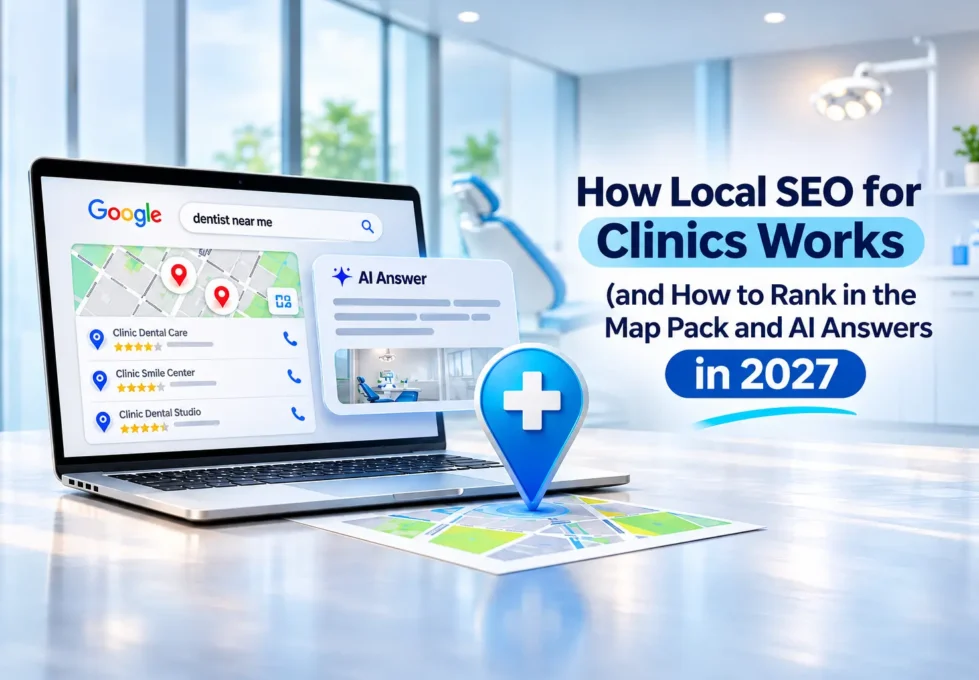
The local pack, the three business listings that appear at the top of a Google search with a map, is where most patient clicks go. The local map pack has become more competitive as practices recognize the revenue impact of local rankings. Getting into those three positions is the primary goal of local SEO for clinics.
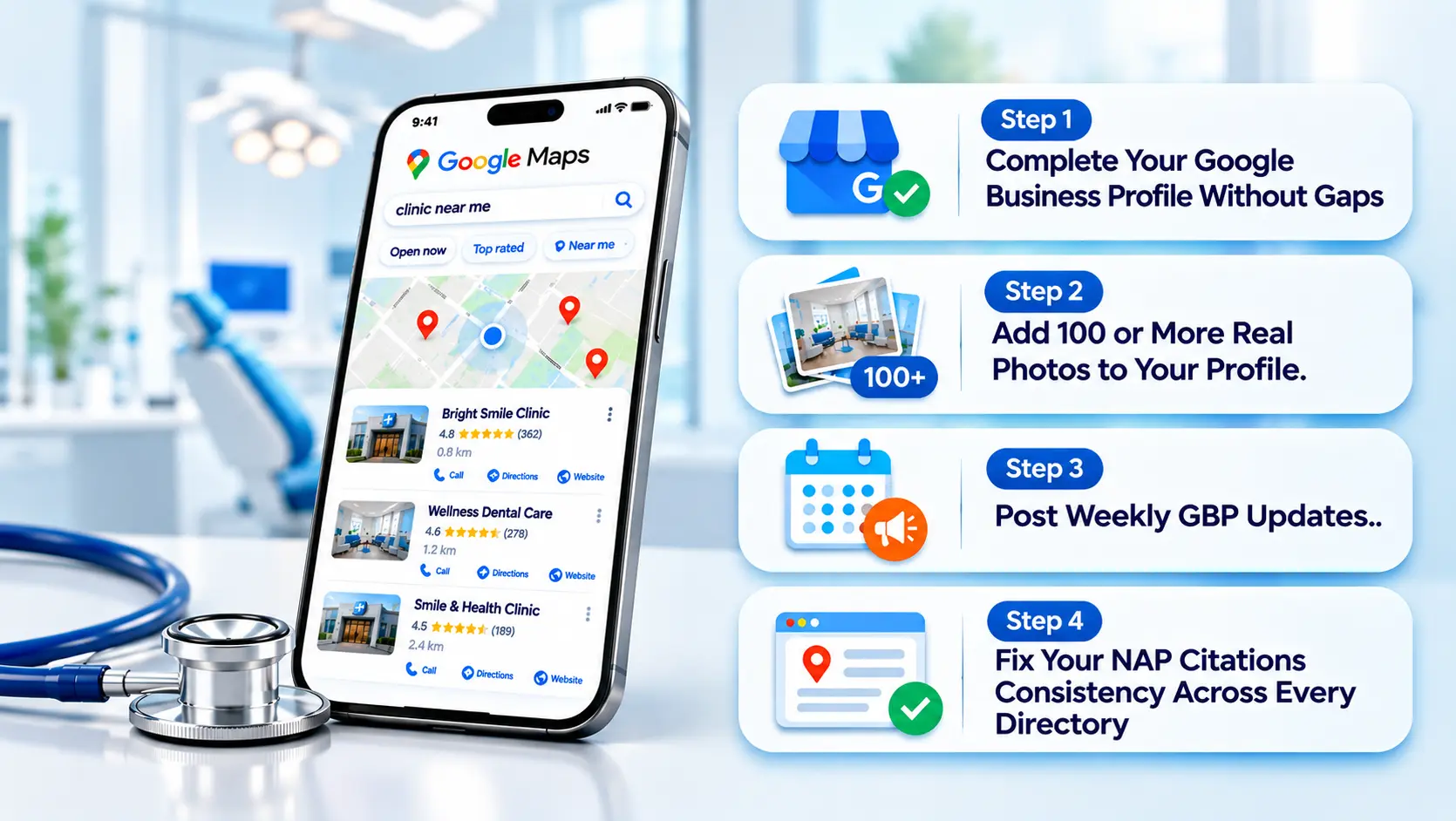
Step 1. Complete Your Google Business Profile Without Gaps
Most clinics have incomplete profiles and do not realize it. Every missing field is a signal Google uses to rank you lower. Your primary category must be specific, for example, “Dental Clinic” or “Skin Care Clinic” rather than just “Health.” Add every service you offer with a real description. Set your hours accurately and update them for holidays. An incomplete profile indicates to Google that you do not actively manage your clinic.
Step 2. Add 100 or More Real Photos to Your Profile
Photo volume is one of the most underused local pack ranking factors. Businesses with more than 100 images on their GBP receive 520% more calls than the average listing. Upload real photos of your reception area, treatment rooms, team members, and equipment monthly. Do not use stock images. Google can identify stock photography, and it does not carry the same trust signal as genuine clinic photos.
Step 3. Post Weekly GBP Updates
Weekly posts on your Google Business Profile signal to Google that your listing is active. Use them to announce new services, share a patient education tip, or highlight a team member. Each post is indexed and visible in your listing for seven days. Clinics that post consistently rank higher for the prominence factor than those that treat GBP as a one-time setup task.
Step 4. Fix Your NAP Citations Consistency Across Every Directory
NAP citations consistency means your clinic’s name, address, and phone number must match exactly. This applies to your GBP, website, Healthgrades, Zocdoc, Yelp, and all other directories where your clinic is listed. One character difference, a missing suite number, or a different phone format weakens your local authority. Audit your citations quarterly and correct any mismatch immediately.
How to Get More Google Reviews for Your Clinic in 2027
Online reviews for clinics are the most visible trust signal on your GBP listing. Steady review velocity matters more than total count. A clinic with 40 reviews posted over the last three months outperforms a clinic with 200 reviews where the most recent one is eight months old. Google reads recency as a signal that patients are still actively choosing your clinic.
The most reliable ways to get more reviews for your clinic on Google:
- Ask at checkout, in person, while the appointment experience is still fresh in the patient’s mind.
- Send a follow-up text within two hours of the appointment with a direct Google review link.
- Train reception staff to mention the review request as a standard part of the checkout script.
- Respond to every existing review, positive and negative. A clinic with 80 reviews and active responses consistently outranks one with 200 unanswered reviews.
- Never offer incentives for reviews. Google’s policy prohibits this, and it puts your profile at risk of suspension.
Real result: Three clinics that ran a consistent GBP optimization strategy saw their average Google Maps position improve from 3.6 to 2.2 in just eight weeks. Profile views jumped 72.8% year over year. The only change was systematic review management and weekly photo uploads.
How Can Clinics Check Their Visibility on Google and Measure Local SEO Progress
Most clinic owners either do not check their local search visibility at all or check it by searching their own name and assuming that means they rank. That is not how patients search. They search by treatment or service, not by clinic name.
Use these free tools to check your real clinic visibility on Google:
- Google Business Profile Insights shows how many people found your listing through direct searches or discovery searches. It also tracks how many clicked for directions or called. Plus, you can see which photos get the most views.
- Google Search Console shows which search queries bring up your website. It also tells you how many impressions you get and your average position for local search terms.
- BrightLocal or Whitespark for tracking your local pack ranking position across different zip codes and service areas, not just your own location
- Search Google Maps using your main treatment category and your city name. Check if you show up in the top three results while logged out of your Google account.
Ready to claim your top spot on Google Search and Maps? Marketing A Clinic helps clinics dominate local search, optimize Google Business Profiles, and capture qualified patient leads. Stop guessing your online visibility. Contact us today to transform your local search presence and scale your clinic profits!
How AI Search Optimization for Clinics Works and Why It Changes Everything in 2027
AI tools like ChatGPT, Perplexity, Gemini, and Google AI Overviews no longer send patients to a list of ten links. They generate one synthesized answer and name one to three recommended providers. If your clinic is not structured to be read by these tools, you do not exist in that answer.
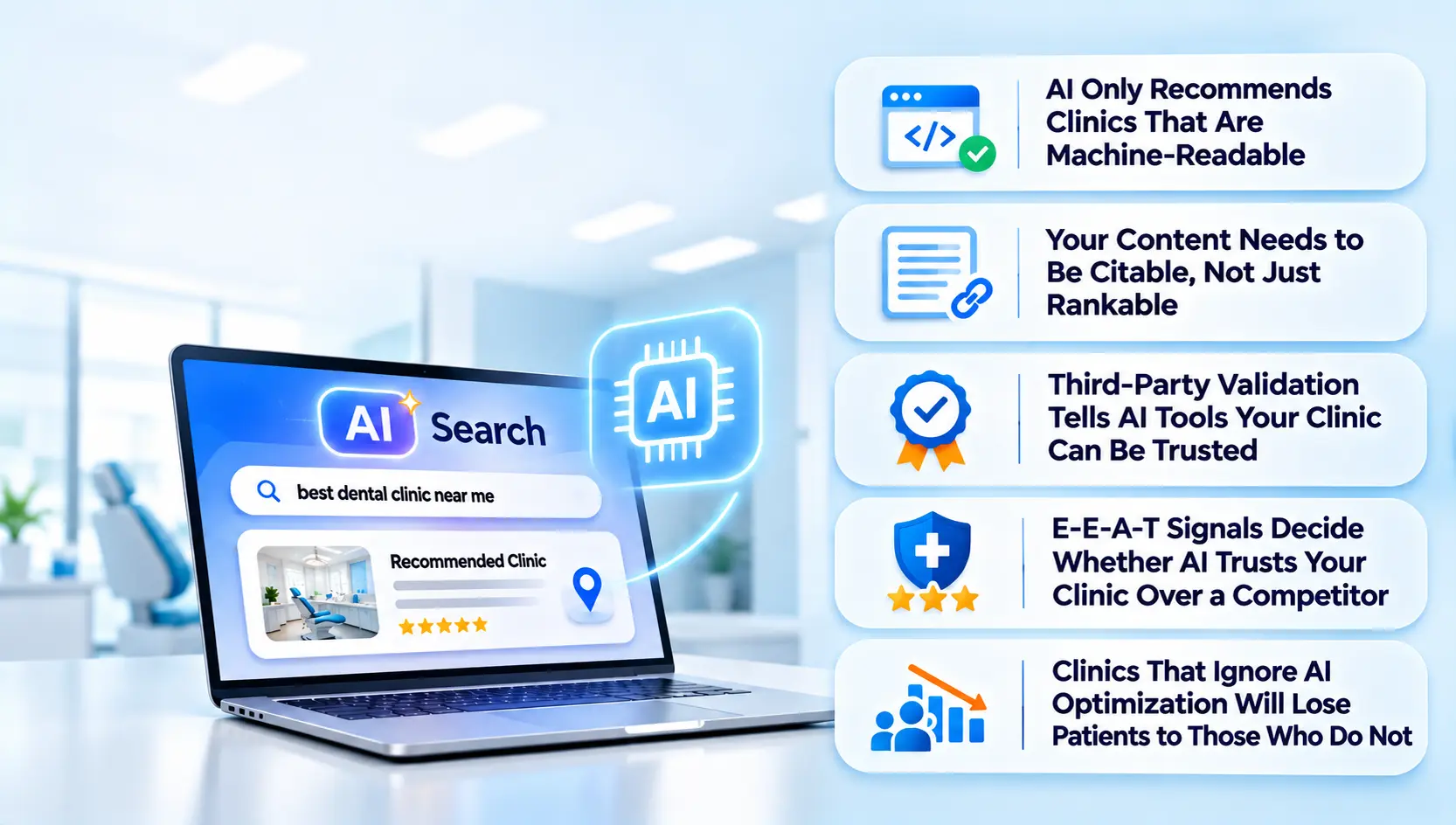
1. AI Only Recommends Clinics That Are Machine-Readable
AI tools cannot recommend what they cannot parse. Schema markup, accurate GBP data, and structured service pages tell AI models exactly what your clinic does, where it operates, and who your staff is. Without this, your clinic is invisible to the recommendation layer.
- Add schema markup for your clinic type, location, services, and medical staff credentials.
- Keep your GBP categories, hours, and service descriptions accurate and fully complete.
- Use an llms.txt file on your website to guide AI crawlers on how to read your practice data.
2. Your Content Needs to Be Citable, Not Just Rankable
AI Overviews quote content directly. A page stuffed with keywords will not be cited. A page that answers one patient question clearly, in plain language, in a short paragraph, will. Writing for AI citation means writing for humans first, then structuring it so the answer is impossible to miss.
- Write one content page per month answering a specific patient question your reception team hears daily.
- Keep answers in the first 100 words of each section, not buried at the bottom of a long page.
- Avoid vague or promotional language. AI tools skip content that does not directly answer the query.
3. Third-Party Validation Tells AI Tools Your Clinic Can Be Trusted
AI systems build consensus across multiple sources before making a recommendation. A clinic present only on its own website carries far less weight than one mentioned consistently across Healthgrades, Zocdoc, Yelp, Google, and niche health directories. Your citation footprint is now your AI trust score.
- Get listed on every major medical directory relevant to your specialty and keep them updated
- Encourage patient reviews across multiple platforms, not just Google alone
- Build genuine mentions on local news sites, health blogs, and community forums where AI tools gather consensus.
4. E-E-A-T Signals Decide Whether AI Trusts Your Clinic Over a Competitor
Google and AI tools evaluate Experience, Expertise, Authoritativeness, and Trustworthiness before citing any healthcare source. Clinics that show verified staff credentials, real patient outcomes, and clear treatment details rank higher on this filter. In contrast, clinics with generic content and no named professionals score lower.
- Add a dedicated team page with each practitioner’s qualifications, years of experience, and specialization
- Use before and after content, patient education articles, and case examples to demonstrate real clinical experience
- Show registration numbers, certifications, and any professional memberships clearly on your website.
5. Clinics That Ignore AI Optimization Will Lose Patients to Those Who Do Not
Traditional keyword SEO puts ten clinics on the results page and lets the patient choose. AI search names two or three and makes the rest invisible. By 2027, patients who use AI tools to find a clinic will rarely scroll past the synthesized recommendation. Second place in that filter means zero bookings from that channel.
- Start with GBP and schema markup as the foundation before investing in any other AI optimization
- Track whether your clinic appears in AI tool answers by testing conversational patient queries in ChatGPT, Perplexity, and Google AI Overviews monthly.
- Clinics that combine strong local SEO with AI readiness will dominate both the map pack and the AI recommendation layer simultaneously.
Quick Visibility Check
Open a private browser window, search your main treatment type plus your city, and see whether your clinic appears in the map pack. If you are not in the top three, your local SEO needs attention before you spend a dollar on paid advertising.
Common Mistakes Clinics Make with Local SEO and Clinic Digital Marketing Services
Most clinics make the same four mistakes. They set up a GBP once and never update it. They run paid ads before their organic presence is strong enough to convert the clicks. They ignore review responses, which signals to Google that the clinic is not actively managed. They use the same description in every directory listing. This cuts down on their local citation footprint.
The specific fixes that move rankings within 30 to 60 days
- Respond to every review posted in the last 90 days, starting today
- Upload 10 real clinic photos this week and set a monthly reminder to add 10 more
- Check your NAP across Google, Yelp, Healthgrades, and your own website footer and fix any mismatches
- Add a booking link directly to your GBP if you do not already have one
- Write one patient question answer page on your website this month and link it from your GBP description
Final Words
Local SEO for clinics is not a one-time task. It is a system. Create your GBP. Manage your reviews. Keep your citations clear. Share content that answers patient questions. The clinics that treat local search as a living channel, not a setup project, are the ones appearing in every patient search that matters in 2027.
Marketing A Clinic audits your Google Business Profile, local search visibility, and citation consistency. We show you exactly which gaps are costing you patient bookings and what to fix first, at no cost. Get Your Free Local SEO Audit!
Frequently Asked Questions
Q1. What is local SEO for clinics and why does it matter?
Local SEO helps your clinic appear in Google Maps and local search results when nearby patients search for your services.
Q2. How do I rank my clinic on Google Maps in 2027?
Complete your GBP. Collect fresh reviews regularly. Add 100 real photos. Fix your NAP citations in all directories.
Q3. How can I check my clinic’s visibility on Google?
Search your treatment type and city in a private browser. If you are not in the top three map results, your local SEO needs work.
Q4. How do I get more Google reviews for my clinic?
Ask at checkout in person and send a direct review link by text within two hours of each appointment.
Q5. What is NAP citation consistency, and does it affect clinic rankings?
Yes. Your name, address, and phone must match exactly across every directory. One mismatch weakens your local authority.
Q6. How is healthcare marketing different from other industries?
Google treats health content as sensitive and holds it to a higher accuracy and trust standard than other business categories.
Q7. How can AI search help clinics get more patients in 2027?
Strong GBP signals and clear website content help your clinic appear in Google AI Overviews before any website result shows up.
Q8. Should clinics invest in local SEO before running paid ads?
Yes. Local SEO builds a free, compounding visibility foundation. Paid ads should amplify what already works organically.