Clinic Marketing: Right Way to Ask Patients for Google Reviews
You just had a great appointment. The patient left happy, your team did everything right, and that person is almost certainly going to tell a friend. But they will never leave a Google review unless you ask. That is the gap most clinics are sitting in right now.
Knowing how to ask patients for Google reviews is one of the highest-return clinic marketing moves a clinic can make in 2026. Google’s local search algorithm weighs review volume and recency heavily, and Google AI Mode now surfaces clinic cards with review summaries directly in search answers. If you are not in those results, a competitor is.
This guide shows you the exact methods, timing, and scripts to fix that. You’ll do it without feeling awkward, crossing ethical lines, or violating patient privacy.
Why Google Reviews for Medical Practice Matter More Than Ever in 2026
In 2026, online reputation for doctors is no longer a bonus. It is a baseline requirement. Google AI Mode generates direct answers to patient queries like “best dentist near me” by pulling from review data, structured content, and trust signals. Clinics with fewer than 30 reviews are being skipped in AI-generated recommendations entirely.
Here is why Google reviews matter for your clinic marketing – the numbers break it down:
Here is the exact table based on the data you provided:
| Review Count | Google Map Pack Visibility | AI Overview Inclusion | Patient Trust Impact |
| 0 to 10 | Very low | Excluded | Significant doubt |
| 10 to 30 | Moderate | Rarely included | Mild trust |
| 30 to 75 | High | Often included | Strong credibility |
| 75 plus | Dominant | Consistently featured | Top patient choice |
The math is simple. More consistent medical practice online reviews equal more visibility, more appointments, and faster clinic growth. Good Clinic marketing brings good traffic.
Can Doctors Ask Patients for Google Reviews? What the Rules Say
Yes, doctors and clinic owners absolutely can ask patients to leave reviews. There is nothing unethical about it as long as you follow the right boundaries. The question is how, not whether.
Is it ethical to ask patients to leave reviews? Yes, as long as you don’t offer incentives for reviews, which breaks Google policy and medical ethics. Also, avoid pressuring patients and discussing specific clinical outcomes that reveal protected health information.
A clean, HIPAA-compliant review request never mentions a patient’s condition, treatment, or visit details. You are asking them to share their overall experience with your clinic, not their medical history. As long as the review request does not reference protected health information (PHI), you are safe.
Quick rule: Ask patients to review the experience of visiting your clinic, not the outcome of their treatment. “Tell others about your visit” is safe. “Tell others how your filling went” is not. clinic marketing is all about reviews.
How to Ask Patients for Google Reviews: The Three-Channel Method
The best way to ask patients to leave a Google review is through a consistent three-channel system, not a one-time ask. This is what top clinics use for review generation in healthcare.
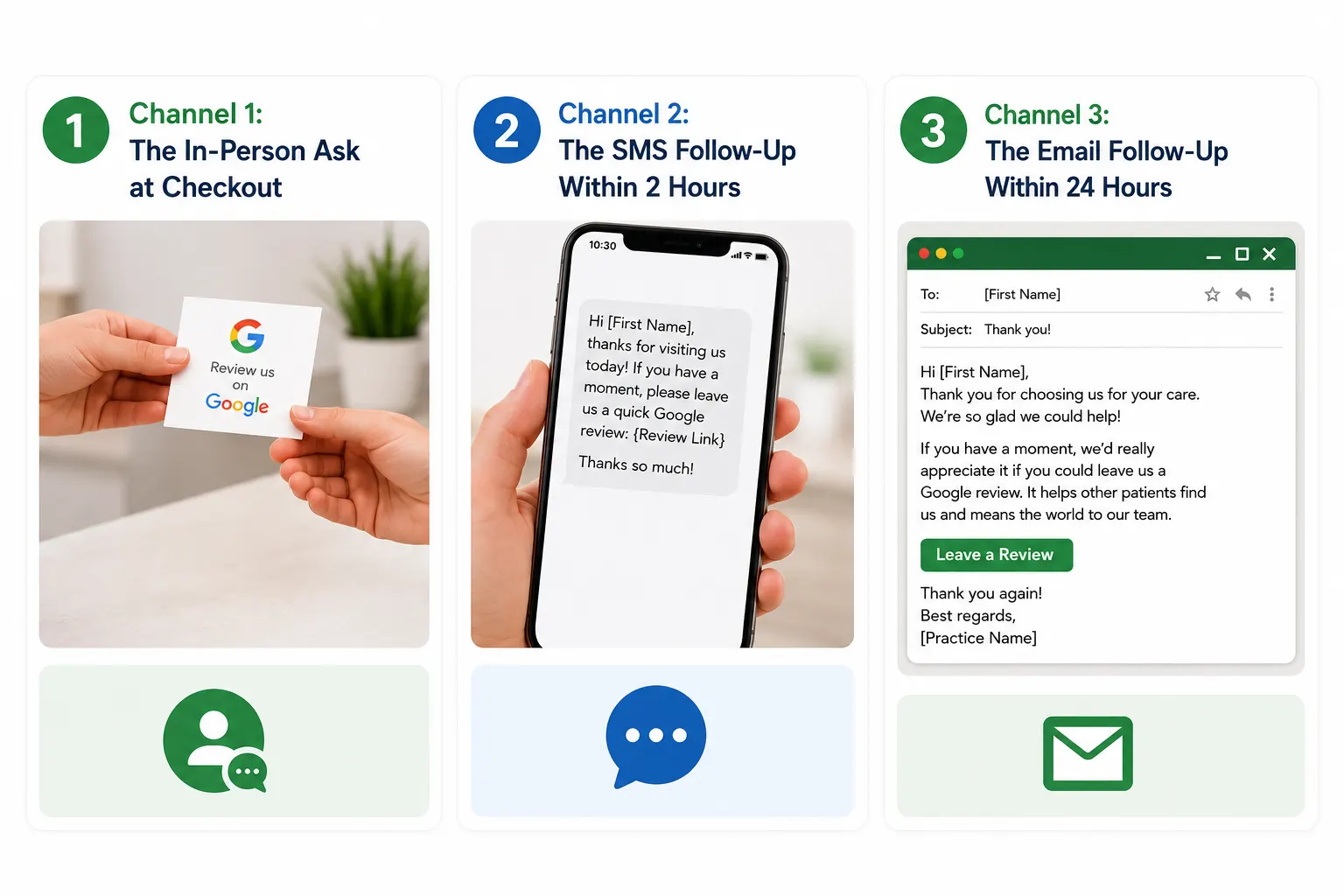
Channel 1: The In-Person Ask at Checkout
The checkout moment is the highest-intent window you have. The patient is still emotionally engaged with the positive experience. Train your front desk to make this a habit, not an afterthought.
Script to ask patients for a Google review (In-Person)
“It was wonderful having you in today. If you have two minutes later, we would really appreciate a Google review. It helps other people in [City] find us. I can send you the link right now if you like.”
Hand them a printed QR code card or text them the direct Google review link on the spot. Reduce friction to zero.
Channel 2: The SMS Follow-Up Within 2 Hours
This is the highest-converting post-visit follow-up message method in 2026. SMS open rates sit at over 90 percent. Send the message within two hours of the appointment while the experience is fresh.
SMS Script (Keep it under 160 characters)
“Hi [First Name], thank you for visiting [Clinic Name] today. We hope you feel great! Would you mind sharing your experience on Google? [Direct Review Link]”
Channel 3: The Email Follow-Up Within 24 Hours
Not every patient will respond to SMS. A well-timed email is your second touchpoint. Keep it short, personal, and direct. One clear call to action, no clutter.
Email Script
Subject: Quick favour from [Clinic Name]
Hi [First Name], thank you for choosing us today. If you had a good experience, we would love for you to share it on Google. It takes less than two minutes and helps patients like you find us. [Leave a Review Button]
Warm regards, [Doctor Name / Team Name]
When to Ask Patients for Google Reviews After an Appointment
When to ask patients for Google reviews after an appointment matters as much as how you ask. Timing is the most overlooked part of any patient feedback strategy.
- 0 to 2 hours post-visit: Best time for SMS. Emotions are high, and memory is sharp.
- Same day, evening: Best time for email. Patient is settled and more likely to act.
- 24 to 48 hours: Acceptable for a single follow-up reminder if they have not responded yet.
- Beyond 72 hours: Conversion drops sharply. Do not push a third ask.
The single biggest mistake doctors make when asking for reviews is waiting too long or not asking at all because it feels uncomfortable. Time kills intent. A patient who felt great during the appointment will feel neutral about it three days later.
How to Politely Ask a Patient for an Online Review Without Pressure
Knowing how to politely ask a patient for an online review is about tone and framing. Never use language that implies obligation. The word “would you mind” consistently outperforms “please leave us” in response tests because it feels like a request, not a demand.
Here are the framing principles that work:
- Lead with gratitude before the ask
- Mention the benefit to other patients, not to your business
- Give them one clear, single-tap link
- Never offer discounts, gifts, or free services in exchange for a review
- Make it easy to decline without awkwardness
A patient satisfaction survey can be used as a pre-screening step. Send a quick internal satisfaction check first. If the patient rates the experience highly (4 or 5 stars internally), immediately follow up with a Google review request. This keeps your public profile strong.
Simple Ways to Get More Patient Google Reviews With Automation
Manual outreach works for small clinics. But if you want to scale, you need automation. The good news is that setting up a review generation in healthcare system today is straightforward and affordable.
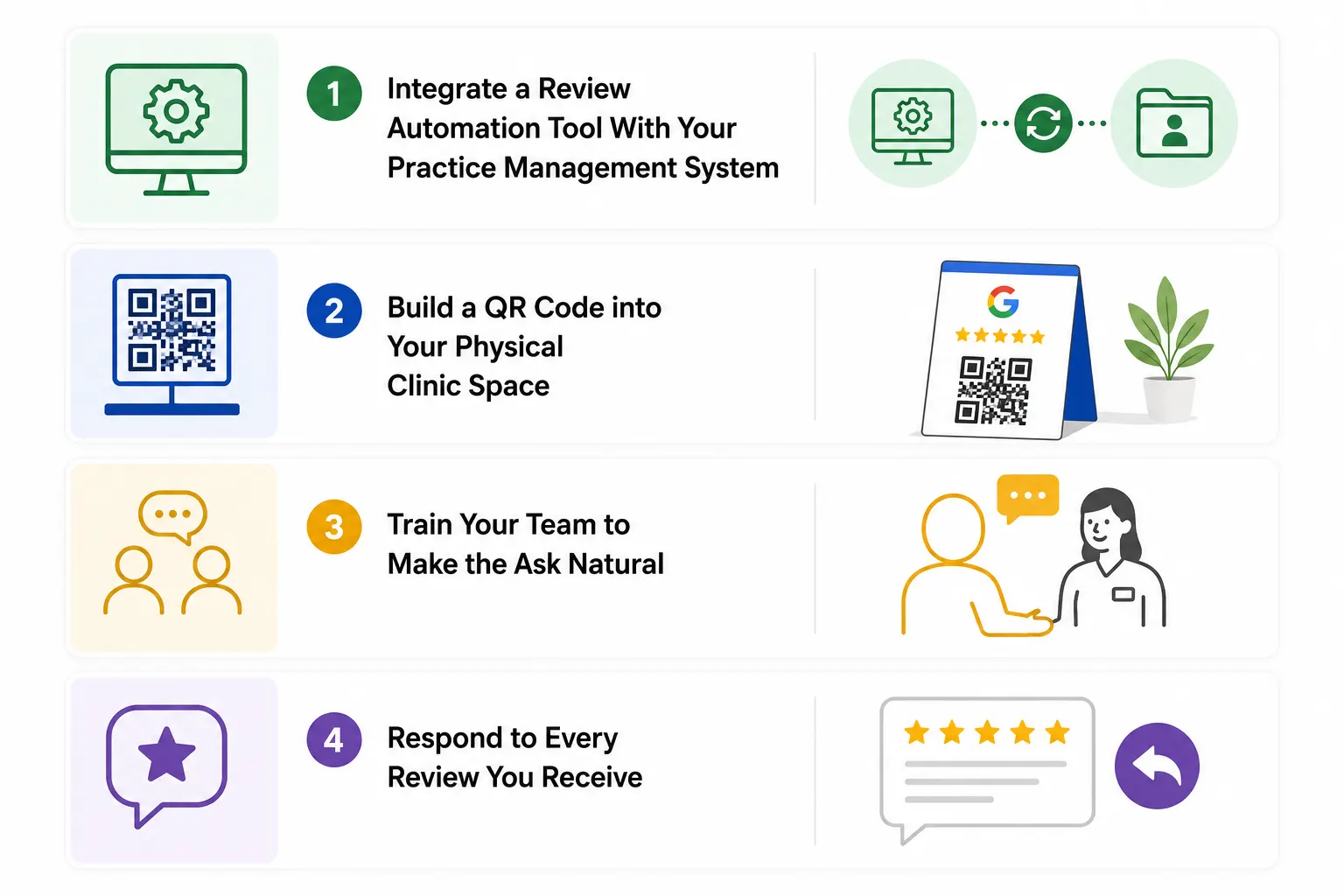 Here is what how top clinics build 5-star Google ratings at scale looks like:
Step 1: Integrate a Review Automation Tool With Your Practice Management System
Tools like Birdeye, Podium, or NiceJob connect directly to your appointment calendar. When a patient’s appointment is marked as complete, the system automatically sends a timed SMS or email with your review link.
Step 2: Build a QR Code into Your Physical Clinic Space
Place a Google review QR code at the front desk, on your appointment card, and at the exit. To get more positive Google reviews, focus on making it easy for happy customers to leave feedback. Remove any obstacles they might face.
Step 3: Train Your Team to Make the Ask Natural
Scripts only work when your team believes in them. Run a short monthly training. Make the ask part of the checkout checklist. Track which team members are generating the most review requests and reward them.
Step 4: Respond to Every Review You Receive
Responding to reviews is a confirmed Google ranking signal in 2026. It also shows prospective patients that you are engaged. Keep responses warm and general, and never reference any clinical details in your reply.
How to Increase Google Reviews for Medical Practice: What Google AI Mode Wants to See
Google AI Mode in 2026 reads your review content semantically. It is not just counting stars. It pulls phrases like “gentle dentist,” “no waiting time,” “friendly staff,” and “easy appointment booking” to create AI-generated summaries for clinics. This means that how to increase Google reviews for a medical practice is also about the quality and specificity of what patients write. You cannot tell them what to write, but you can make it easy by giving them a starting point.
What is the right way to ask patients for reviews? It is the approach that is timely, personal, frictionless, and consistent. Not a one-time ask during a push campaign, but a permanent part of how your clinic marketing operates. Every clinic that grows its Google rating from 3.8 to 4.7 does it the same way: they make asking for reviews a daily practice, not a periodic effort. That is the real answer to patient review tips every doctor should know.
Start Getting More Patient Reviews Today With Marketing A Clinic
Clinics that ask consistently outrank clinics that ask occasionally. Now you have the scripts, the timing, and the system. The only thing left is making it part of how your clinic runs every single day and how you do your clinic marketing.
Marketing A Clinic builds done-for-you review strategies for dental and beauty clinics. From automated follow-up sequences to Google AI-ready reputation systems, we handle the entire process so your team focuses on patients, not chasing feedback. Book your free strategy session and start growing.
Frequently Asked Questions
Q1. What is the right way to ask patients for reviews? A
Skip in person at checkout, follow up via SMS within 2 hours, and keep the review request warm and frictionless.
Q2. Can doctors ask patients for Google reviews?
Yes, doctors can request healthcare Google reviews as long as they never disclose or reference any patient health information.
Q3. Is it ethical to ask patients to leave reviews?
Yes, it is ethical to ask for medical practice online reviews, provided you are not offering incentives or creating pressure.
Q4. How to ask for patient reviews without violating HIPAA?
A HIPAA-compliant review request asks about the clinic experience only, never mentioning treatment, diagnosis, or health conditions.
Q5. What is the best time to request a Google review from a patient?
The best time is within 2 hours post-visit via SMS as part of your post-visit follow-up message strategy.
Q6. What mistakes do doctors make when asking for reviews?
The top doctor review request mistake is waiting too long after the appointment when patient enthusiasm has already dropped.
Q7. How do top clinics build 5-star Google ratings consistently?
Top clinics use automation and trained staff to include review generation in their daily checkout process.
Q8. Do Google reviews help clinics rank in AI Overview?
Yes, a consistent online reputation for doctors with high-volume, descriptive reviews directly improves Google AI Overview inclusion.
Q9. What should a Google review request SMS say?
A strong patient feedback strategy SMS thanks the patient, mentions sharing their experience, and gives one direct link to the review.
Q10. How many Google reviews does a clinic need to rank well?
For solid clinic reputation management, aim for 75 or more reviews with consistent new ones monthly to stay visible.
Q11. Should I respond to every patient Google review?
Yes, responding to every healthcare Google review is a ranking signal and builds trust with new patients researching your clinic.
Q12. How to use a patient satisfaction survey before asking for a review?
Send a quick internal patient satisfaction survey first. If the rating is 4 or 5 stars, immediately trigger your Google review request.