
Local SEO for a Dental Clinic: How to Optimize Your Google Business Profile
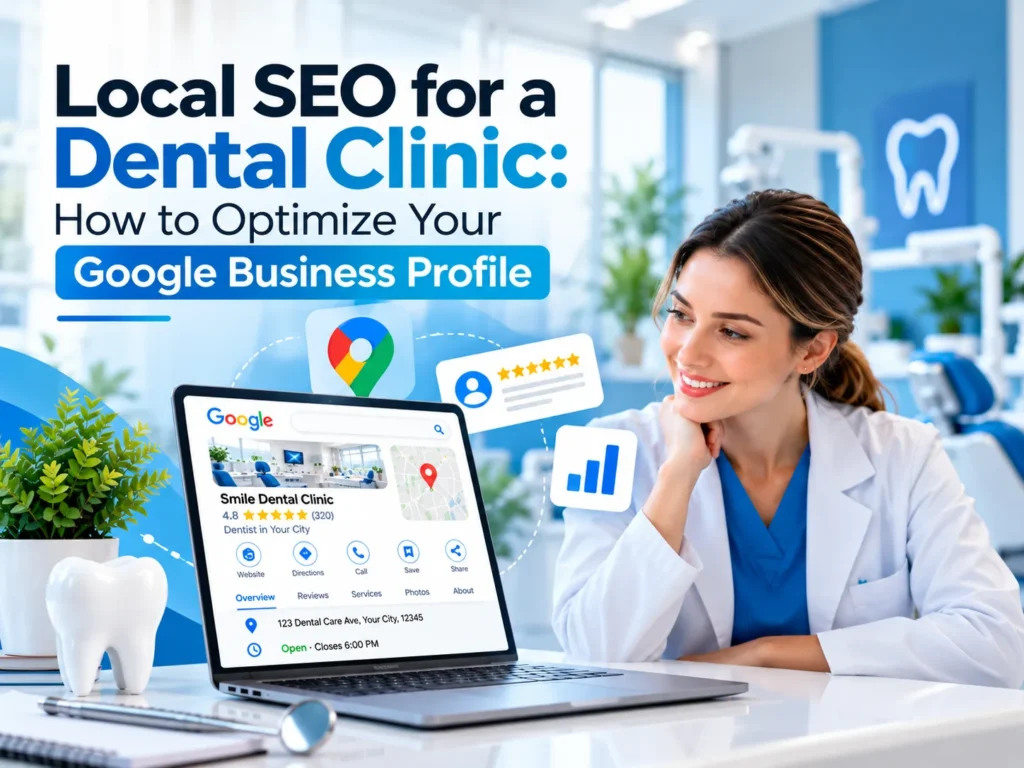
Your Google Business Profile is not a directory listing. In 2026, it is the single most important asset in your clinic’s entire digital presence, and most dental practices are still treating it like a form they filled out once and forgot. Every patient who searches “dentist near me” sees your GBP before they see your website. Every AI tool that recommends a local dentist pulls from your profile data first. Getting local SEO for a dental clinic right starts here. A full and active profile gets 7x more clicks than a partial one. The Google Map Pack, which shows complete profiles, receives about 48% of all local dental search clicks. This blog gives you a practical, step-by-step breakdown of exactly how to optimize your Google Business Profile so your practice shows up first, not fourth. Why Google Business Profile Is Your Most Important Local SEO Asset According to BrightLocal’s 2026 local ranking factors study, GBP signals account for 32 percent of your total Local Pack ranking weight. No other single factor comes close. Your profile is the most valuable part of your local SEO strategy for a dental clinic. However, many clinics don’t complete it. 32% of Local Pack ranking weight comes from GBP signals (BrightLocal 2026) 7x more clicks for a complete GBP versus an incomplete one 48% of all local dental search clicks go to the Google Map Pack results A patient searching for a dentist on Google sees three things before anything else. The Map Pack, the star rating, and the number of reviews. If your profile is missing photos, has no recent posts, and sits at 3.8 stars with 12 reviews, you are invisible regardless of how good your care actually is. This is exactly where dental Google rankings are won or lost before a patient ever visits your website. How to Rank Your Clinic on Google Maps: Profile Setup Done Right Getting how to rank my clinic on Google Maps right comes down to three structural decisions most practices get wrong from the start. 1. Primary Category Your primary category must be “Dentist,” not “Dental Clinic” or “Health Consultant.” Google’s guidance shows that the primary category is a key local ranking signal. “Dentist” is the term that patients really search for. Add secondary categories for each service you truly offer. The most common are Cosmetic Dentist, Emergency Dentist, Pediatric Dentist, and orthodontists. 2. Services and Description List every treatment as a separate service entry, not as a single paragraph. Invisalign, dental implants, teeth whitening, and same-day crowns should each have their own entry with a brief, patient-facing description. Your business description should include your city name and two or three specific treatments. Stay under 750 characters and avoid using ALL CAPS or superlatives. These choices can breach GBP content guidelines and may lead to profile issues. 3. Photos and Activity Profiles with more than 100 photos generate approximately 3x the monthly profile actions compared to sparse profiles. Upload clinic exterior and interior shots, team photos, and treatment-specific images. Google favors active profiles, so add at least two to three new photos every month. Post one to two times a week using GBP. Use location and treatment-specific terms to keep your content relevant for Google Maps SEO for dental clinics. 2026 data point: Profiles with over 100 photos get about 600 calls, direction requests, and website clicks each month. In contrast, sparse profiles average only around 200 actions. How to Get More Reviews for Your Clinic on Google Reviews are one of the three primary dental Google ranking signals alongside relevance and distance. But in 2026, review quality matters as much as volume. A clinic with 150 reviews that mention treatments like Invisalign, implants, or emergency care does better than a clinic with 300 generic five-star reviews. This holds for both Map Pack rankings and AI citation. How to get more reviews for my clinic on Google is not complicated, but it requires a system rather than occasional reminders. Send the review request via SMS within two hours of the appointment while the experience is fresh Follow up by email 48 hours later if there is no response Give patients a direct review link, not instructions to find it themselves Ask patients to mention the specific treatment they received, not just general feedback Respond to every review within 48 hours, positive and negative, since response activity is a ranking signal Trust Threshold 2026: BrightLocal’s 2026 survey showed that 68% of patients prefer practices with 4 stars or more. Also, 47% won’t consider a practice unless it has at least 20 reviews. AI tools set the bar higher still, rarely citing a practice by name until it crosses roughly 150 reviews. How Can I Check My Clinic’s Visibility on Google Every practice owner should regularly ask, “How can I check my clinic’s visibility on Google?” It’s important to stay on top of this. The main tool is Google Search Console. Since the update on June 3, 2026, it now has a special AI Overviews and AI Mode impressions report. This marks the first time AI visibility is separate from regular click data. Now, you can see how often your practice shows up in AI-generated answers. For Map Pack visibility specifically, use the GBP Insights dashboard inside your profile. It shows how patients found your profile through direct search or discovery search. It also details what actions they took, like calls, directions, or website clicks. Plus, it compares your photo views to those of similar businesses. These metrics tell you whether your healthcare local SEO is translating into real patient actions or just impressions. Visibility Check Where to Find It Map Pack and organic ranking position Google Search Console, performance report, filter by local queries AI Overview and AI Mode impressions Google Search Console, AI Overviews report (launched June 3 2026) Profile actions (calls, directions, clicks) GBP Insights dashboard inside your Google Business Profile Review sentiment and response rate GBP Reviews tab and third party tools like
5 Signs Your Clinic’s Google Ads Budget Is Being Wasted
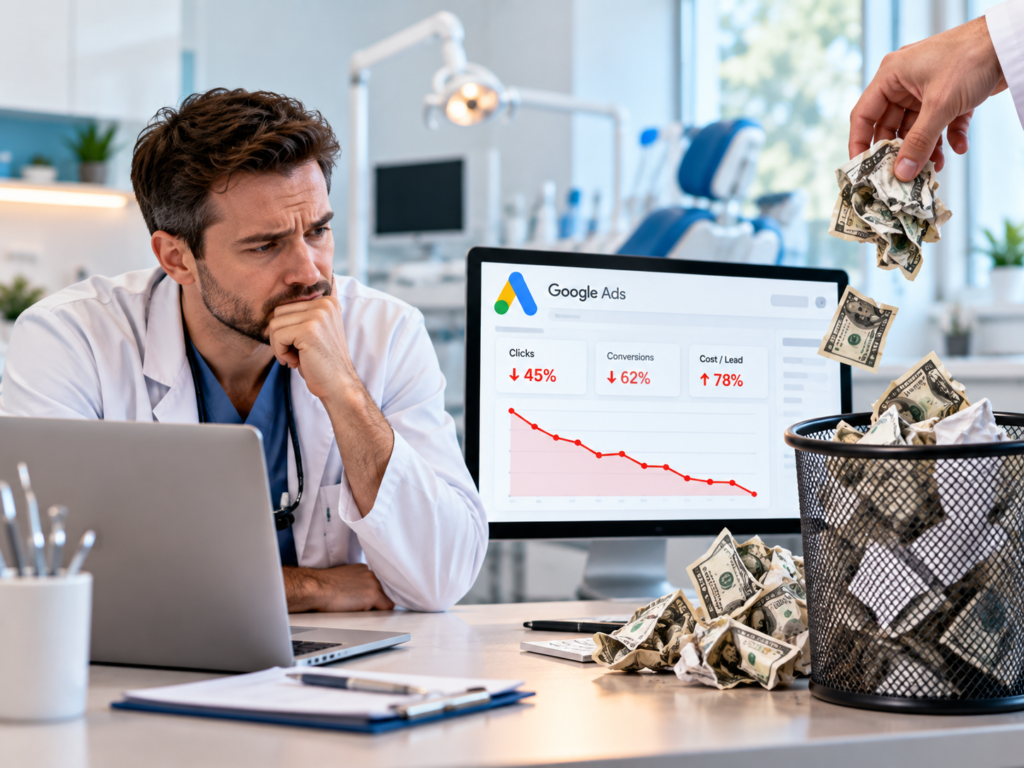
Quick Summary The most common signs your Google Ads budget is being wasted are invisible inside the Campaigns tab and only show up in the Search Terms report. Clinic Google Ads mistakes like running broad matches without a proper negative keyword list silently drain the budget on patients who will never book. Without conversion tracking for phone calls, Google’s algorithm optimizes for clicks instead of actual patient appointments. Medical practice PPC wasted spend compounds when agencies set campaigns once and leave them running without weekly review. The fix for Google Ads for clinics not working starts with auditing match types, tracking setup, and landing page performance together, not in isolation. Clinic owners who reduce Google Ads spend in healthcare successfully do it by cutting irrelevant traffic first, not by reducing budget across the board. Over 60% of clinic owners running Google Ads have no idea how much of their budget is spent on people who will never become patients. The signs your Google Ads budget is being wasted are rarely obvious on the surface. Your dashboard shows clicks, your ad shows impressions, and your agency sends a report with green numbers. Yet the appointment book stays half empty. If you run a dental, skin, hair, or wellness clinic and your Google Ads are not generating consistent patient inquiries, the problem is almost never the platform. It is how the campaigns are set up and managed. This guide highlights the five most common waste signals in clinic ad accounts. It shows you what to check in your own dashboard today. What Causes Google Ads Budget to Be Wasted for Clinics Most clinic owners assume Google Ads budget waste because of high competition or expensive keywords. The real cause is almost always structural. Campaigns using broad match instead of exact match often go unchecked. When conversion goals focus on page visits rather than actual bookings, they waste money. Also, ad groups that target the wrong intent quietly drain budgets without clear warnings. Google can spend your full ad budget even when clicks don’t convert. Without proper targeting and tracking, a clinic spending ₹50,000 monthly could waste thousands. These five signs can help identify where your healthcare ads are losing money. 2026 Benchmark: Google Ads accounts in healthcare and medical services that lack a negative keyword list send about 30 to 50% of total spending to non-patient queries. This includes job searches, requests for free treatments, and competitor brand names. This is confirmed across multiple PPC audit studies published in 2025 and 2026. Sign 1: Your Search Terms Report Is Full of Irrelevant Queries What to Check Open your Google Ads account and go to Keywords, then Search Terms. Sort by cost, highest first. Read through the top 50 terms your ads actually showed up for. This is one of the clearest signs your medical practice PPC campaign is failing. If you see queries like “free dental treatment,” “how to do teeth whitening at home,” “dentist salary,” or competitor clinic names you never intended to target, your budget is being consumed by people who are not patients. This happens because Google’s default settings, like broad match, let your ads show up for any query that Google thinks is related to your keywords. For a clinic targeting “dental implants,” broad matches can trigger ads for “dental implant cost DIY” or “dental implant jobs in Mumbai.” Both clicks cost real money, and neither will ever book an appointment. Left unchecked, this steadily drains your Google Ads budget week after week. How to Fix It Add a negative keyword list immediately. Start with words like “free,” “cheap,” “jobs,” “salary,” “home remedy,” “DIY,” “course,” and “review.” Switch high-volume keywords from broad match to phrase match or exact match to tighten control over which searches trigger your ads. Review the Search Terms report every week for the first 60 days of any new campaign. Add new negatives each time. This is one of the most common clinic Google Ads mistakes and the fastest to fix once identified. Sign 2: Phone Calls Are Not Being Tracked as Conversions Calls Drive Bookings For clinics, the phone call is the most valuable conversion action. A patient who calls your clinic is far more likely to book than one who fills out a contact form. Yet most clinic ad accounts track only form submissions or website page views as conversions. This means Google’s algorithm is optimizing to get more people to visit your website, not to get more people to call and book appointments. Without proper conversion tracking for phone calls, you are flying blind. Your account might show 80 conversions in a month while your front desk team took only 12 patient calls from ads. The discrepancy comes from 68 conversions. These were people who clicked your home page but didn’t take any meaningful action. Google counted them as converted because the tracking was set up incorrectly. Fixing this single issue often protects a significant share of your Google Ads budget. What Good Tracking Looks Like Set up call tracking using Google Ads call extensions with call conversion actions tied to calls over 60 seconds in length. Use Google’s forwarding number feature so every call from an ad click is counted as a conversion separately from organic calls. Remove page visit-based conversions from your primary conversion actions and keep only real patient intent signals like calls and appointment form completions. Once tracking is clean, your cost per acquisition in healthcare reporting will reflect actual patient acquisition cost, not vanity metrics. “If your Google Ads account is tracking website sessions as conversions, your campaign is optimizing to send more visitors to your homepage. That is not a patient acquisition strategy. That is a traffic strategy dressed up as one.” Sign 3: Your Quality Score Is Low, and Your CPC Keeps Rising Quality Score Explained Quality Score in Google Ads is Google’s rating of how relevant your ad, keyword, and landing page are to the person searching. It is scored from 1
Local SEO Checklist for Dental Clinics in Connecticut (2026 Edition)
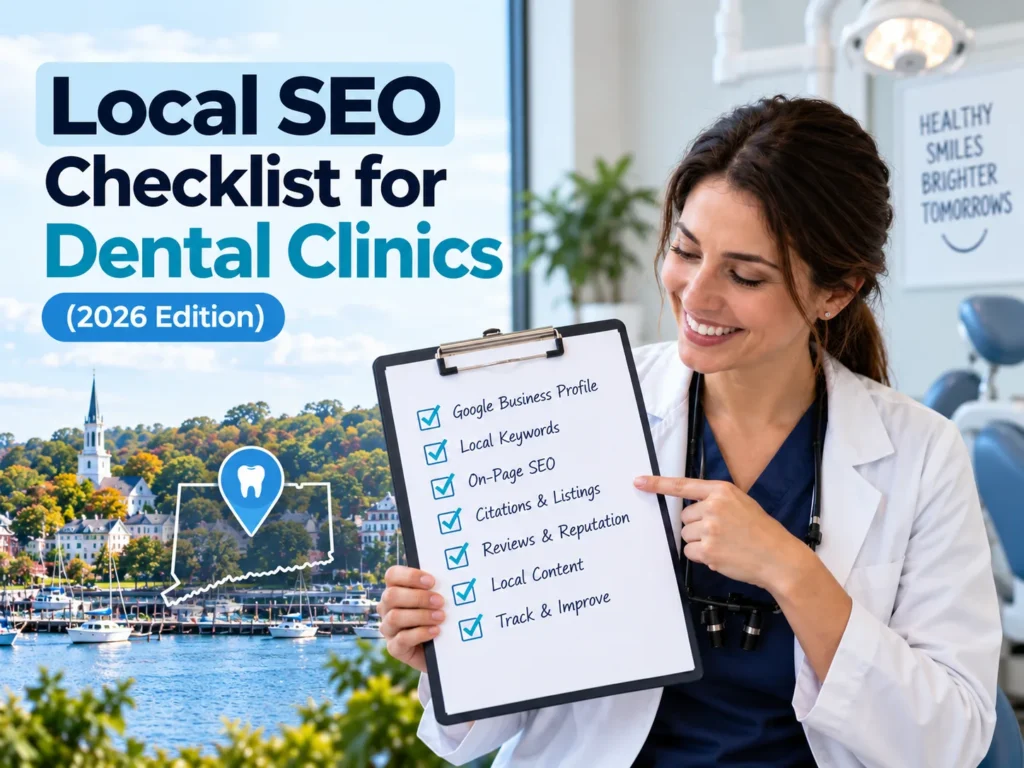
Quick Summary The local SEO checklist for dental clinics covers every 2026 Google ranking signal. Google Business Profile optimization for dentists directly controls your Google Maps pack visibility. NAP consistency, local citations, and schema markup are the foundation of local rankings. Reaching 150-plus reviews pushes your clinic into Google AI Overview answers faster. Dental clinic marketing in Connecticut now requires AI search signals alongside traditional local SEO. If your dental clinic is not showing up when someone types “dentist near me” or “emergency dentist in Connecticut”, you are losing patients to competitors who are doing the basics right. The local SEO checklist for dental clinics in this guide is built for 2026 realities, not 2022 advice you find recycled across most marketing blogs. Google has shifted. AI Mode is now surfacing answers before patients even click a website. Your practice needs to be cited inside those answers. This is a complete, no-fluff guide that walks you through every step that moves the needle for local SEO for dentists in Connecticut. Whether you run a solo practice in Waterbury or a multi-chair clinic in Stamford, this checklist applies directly to you. What Is Local SEO for Dental Clinics and Why It Matters More in 2026 Local SEO for dental clinics means tuning every online signal. This helps Google link your practice to patients searching in your area. In 2026, this includes your Google Business Profile, website content, structured data, review count, citation accuracy, and your presence in AI-generated answers. Google AI Overviews now appear above organic results for queries like “What should be included in a dental SEO checklist” or “How do dentists rank higher on Google Maps?” If your clinic is not structured to be cited in those AI answers, you are invisible to the first wave of patients who never scroll past the AI block. 2026 Signal: According to Google Search Console data tracked through June 2026, AI Mode impressions are now reported separately from standard search impressions. Dental clinics showing in AI Overviews receive 2 to 4 times more branded searches within 30 days of the first AI citation. The Full Dental SEO Checklist 2026: 8 Steps That Actually Move Rankings 1. Complete Your Google Business Profile Without a Single Gap Google Business Profile optimization for dentists is the single highest-impact action on this entire checklist. An incomplete GBP keeps you out of the Google Maps pack no matter how good your website is. Fill in all fields. Include your practice name, address, phone number, and website URL. Don’t forget the appointment link and your business hours, including any holiday hours. Write a 750-character description that naturally mentions your city and core treatments. Select the correct primary category, which is “Dentist,” and add relevant secondary categories such as “Cosmetic Dentist,” “Pediatric Dentist,” or “Emergency Dental Service” wherever they apply to your practice. Google uses these categories to match your profile to the right patient searches. Missing a secondary category means missing every search tied to it. 2. List Every Service and Treatment Individually Inside GBP Google lets dental clinics list individual treatments on their Business Profile. Adding services like implants, Invisalign, whitening, and cleanings is an important step in a local SEO checklist for dental clinics in Connecticut. Fact: Google’s GBP documentation from early 2026 shows that profiles with complete service listings get 42% more direction requests and 35% more website clicks than those without service entries. 3. Build NAP Consistency Across Every Directory NAP consistency means your practice name, address, and phone number appear identically on every platform where you are listed. Google cross-references your GBP details against dozens of third-party sources. A single variation, such as “Suite 4” on your website but “Ste 4” on Yelp, creates a conflicting signal that suppresses your Maps pack ranking. Audit every existing directory listing before building new ones. Use the exact same business name format across Google, Yelp, Healthgrades, Zocdoc, and WebMD. If your phone number or address has changed in the past two years, update every citation source manually. Automated tools often leave mismatches behind. Check your own website footer, contact page, and schema code against your GBP listing and confirm they match character for character. 4. Build Local Citations on the Right Platforms Local citations are listings of your practice on third-party directories. Each accurate citation reinforces your geographic authority with Google. For dental clinics in Connecticut, the main citation sources are: Yelp Healthgrades Zocdoc WebMD Connecticut State Dental Association directory City-specific directories for Hartford, New Haven, Bridgeport, Stamford, Norwalk, and Waterbury. Build citations in order of domain authority. General directories like Yelp and Healthgrades first, then Connecticut-specific business directories, then local chamber of commerce listings. Each one sends a geographic relevance signal that compounds over time. A dental clinic with 60 consistent citations outranks one with 10 inconsistent ones every time. 5. Add Schema Markup That Tells Google Exactly What You Offer Schema markup is structured data in your website code. It tells Google about your business type, the treatments you offer, your location, accepted insurance, and your operating hours. In 2026, Google uses schema as a primary input when generating AI Overview answers. A dental clinic with a complete Dentist schema, including hasOfferCatalog for individual treatments, is significantly more likely to be cited when a patient asks a question Google answers with an AI Overview. Add the Local Business and Dentist schema to your homepage. Add the service schema to each individual treatment page. Include geo coordinates, accepted payment types, and insurance networks in your schema where possible. Add FAQ schema to your service pages. This creates rich results under your organic listing and feeds AI Overview answer pools simultaneously. 6. Upload Fresh Photos and Post Weekly to Stay Active Google’s local ranking algorithm rewards active profiles. Clinics that post weekly GBP updates and upload fresh photos consistently outrank static profiles in the same geography even when the static profile has a higher review count. Post weekly about promotions, new treatments, team introductions, and
AI Search Optimization for Dental Clinics: Complete 2026 Guide
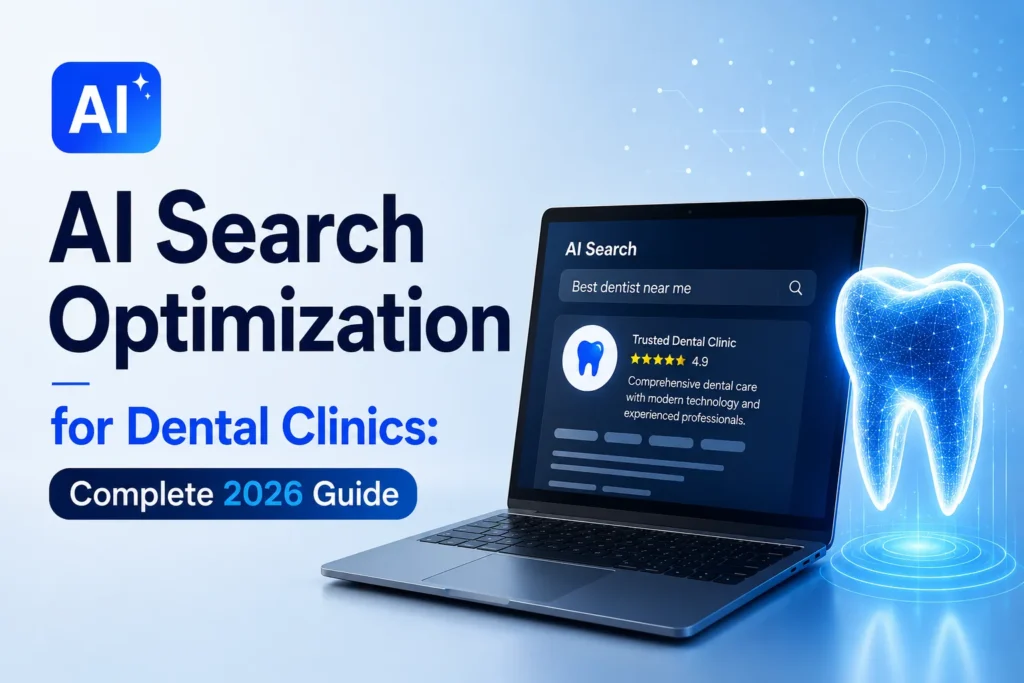
Google Search has changed dramatically in 2026. Patients are no longer scrolling through ten blue links before choosing a dentist. Many searches now display AI-generated answers, AI summaries, and conversational recommendations before users visit a website. For dental practices, this means traditional SEO alone is no longer enough. Clinics must optimize their websites so AI systems can easily understand, trust, and recommend their content. The clinics that appear in AI-driven search experiences gain more visibility, more trust, and more patient inquiries. That is why AI search optimization for dental clinics has become a critical marketing priority for 2026. What AI Search Optimization for Dental Clinics Actually Means in 2026 Traditional dental SEO in 2026 was about ranking a webpage at position one. AI search optimization is about getting your clinic cited inside an AI-generated answer. Those are two different outcomes, and they require two different approaches. When a patient searches for “best dental clinic near me 2026” on Google, the AI Overview at the top gathers details from reliable sources. It offers a clear recommendation. There is no scroll. There is no comparison. The AI names a clinic, and the patient calls. If that clinic is not yours, the visit never happens. 40%+ of all informational queries absorbed by Google AI Overviews before a click 90% of AI Mode responses feature established brands with structured data 97% of patients research dentists online before booking an appointment How does AI recommend dentists online? It uses authority signals such as your Google Business Profile, structured data on your site, the number and detail of reviews, and how well your content answers real patient questions. Clinics that check all those boxes get cited. Clinics that do not exist are invisible. How to Optimize Dental Clinic for AI Search in 2026: The Foundation Before you build any content strategy, three foundational signals need to be in place. These are what AI engines use to decide whether your clinic is credible enough to recommend. 1. Your Google Business Profile Is the AI’s Primary Source Your GBP is the single most referenced asset in AI local SEO dentist rankings. Your profile’s completeness and activity level decide if you show up in the Map Pack and AI Overview recommendations. Name, address, and phone must be identical across every directory Select all relevant categories, such as Dentist, Cosmetic Dentist, Dental Implants, and Orthodontist Upload clinic photos, staff photos, and procedure photos monthly Post weekly updates using service-specific language that your patients actually search for Enable the appointment booking link and keep your hours accurate in real time 2. Structured Data Tells AI What Your Clinic Does Dental website structured data is how you communicate directly with AI crawlers in a language they understand. Without it, even a quality website is hard for AI systems to understand and cite correctly. Add a Local Business schema with your clinic’s NAP details. Include DentistSchema if it’s available. Use FAQPage schema on each service page. Implement BreadcrumbList schema to show site hierarchy. In 2026, how dentists are winning with AI search comes down largely to this technical layer that most competitors are ignoring entirely. 3. Review Specificity Beats Review Volume A clinic with 200 generic five-star reviews will often lose in AI citations to a clinic with 100 reviews where patients specifically mention treatments like Invisalign, root canal, or teeth whitening. AI-generated dental recommendations are built from semantically rich review content. Encourage patients to write about the specific treatment they received, not just a generic “great experience.” AI Search Engine Optimization Guide for Dentists: Content That Gets Cited Content is where most dental clinics fall short in dental practice online visibility. Thin service pages with a list of treatments and a phone number do not get cited in AI answers. Content that directly answers specific patient questions does. 1. Build Question-First Service Pages Every service page should start with the most common patient question about that treatment. Then, provide a clear answer of 40 to 60 words right below the heading. This format mirrors how AI extracts snippets. For example, a dental implants page should open with “How long do dental implants last?” followed by a precise, factual answer before any other content appears. This is the core of how to rank dental practices on AI-powered search. AI does not reward pages that eventually get to the answer. It rewards pages that lead with the answer. 2. Target Local Search Intent With Hyper-Specific Content Local search intent for dentistry in 2026 is driven by urgency and specificity. Patients are not searching for a “dental clinic.” They are searching for “emergency dentist open Sunday in [City]” or “affordable dental implants in [Area].” Your content must match that specificity. Create dedicated pages for each treatment category, each patient concern, and each city or area you serve. A single generic “Services” page is invisible to AI. Ten specific, well-structured pages are citation-ready assets. 3. Use Voice Search Optimization for Natural Language Queries Voice search for dentists now accounts for a significant share of local dental queries, particularly on mobile. Voice queries are conversational: “Who is the best dentist near me for children?” Write FAQ sections in natural spoken language. Use complete questions as H3 headings. Give direct one-sentence answers before expanding. This is how top-rated dentist AI search answers are structured. Dental Clinic Search Ranking in Google AI Overviews: What the Algorithm Prioritises Understanding Google SGE dental results and how AI decides what to surface is not guesswork in 2026. The signals are consistent and documented. Here is how they stack up. Ranking Signal Weight in AI Citations What to Do Google Business Profile completeness Very High Fill every field, post weekly, add photos monthly Review volume and specificity Very High Ask for treatment-specific reviews and respond to every one Structured data markup High Add LocalBusiness and FAQPage schema to all pages Question-first content format High Lead every service page with a direct patient question and answer Page load speed under 100ms for AI
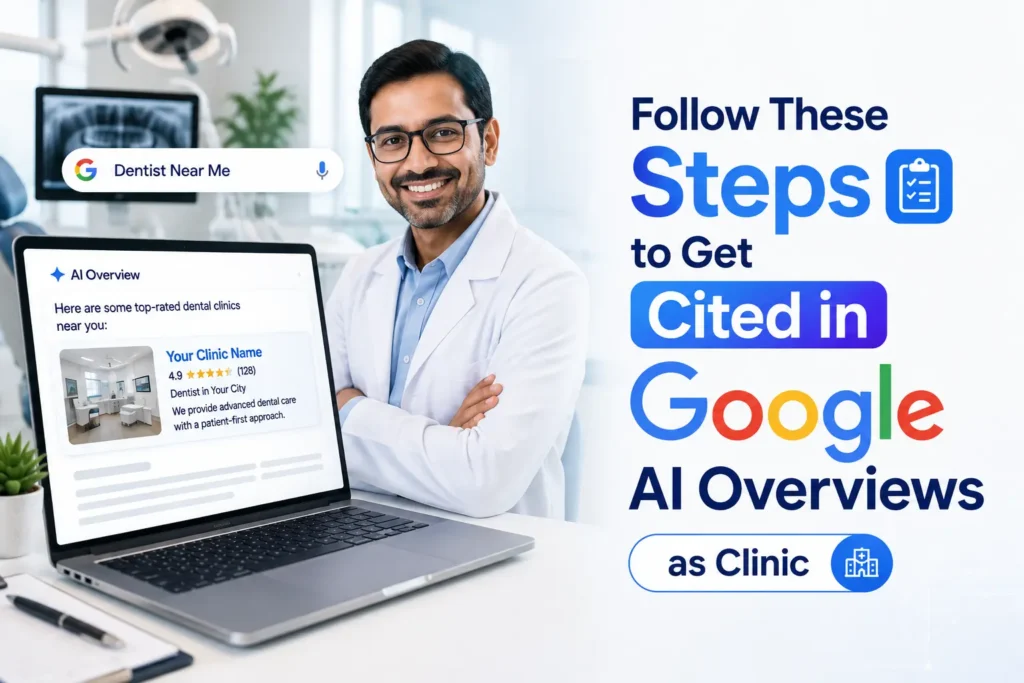
Follow these Steps to Get Cited in Google AI Overviews as Clinic
Quick Summary Google AI Overviews for dental clinics now appear on 88% of healthcare-related searches, making citations as important as ranking on page one. Brands cited inside an AI Overview earn 35% more organic clicks and 91% more paid clicks than brands left out entirely. Generative engine optimization for dentists requires a different content structure than traditional SEO, built around direct, citable answers. Dental SEO-structured content for AI citation means writing every page so that a single paragraph can stand alone as a complete answer. Google Business Profile optimization for dental AI visibility still matters, since AI systems pull heavily from sources that already rank well. This guide explains the exact GEO vs traditional SEO for dental practices, which is better in 2026, and how Marketing A Clinic applies both together. Google AI Overviews now trigger on roughly 88% of healthcare-related searches, the highest rate of any industry category tracked in 2026. For dental practices, more patients are asking about Invisalign, implants, and emergency care. Many of these questions get answered right on the search results page, often before they even see a website link. Brands mentioned in that AI summary get 35% more organic clicks and 91% more paid clicks than brands not mentioned, according to Seer Interactive’s 2026 analysis. Google AI Overviews for dental clinics are now a key ranking factor. Many practices haven’t updated their content to keep up. What Are Google AI Overviews and How Do They Affect Dental Clinics What Google AI Overviews are and how they affect dental clinics comes down to one shift. Google stopped returning ten blue links for many searches and started generating a direct, synthesized answer instead. The AI reads several authoritative pages, then writes a short summary citing a handful of sources. For dental clinics, this is important. Questions like “What is the average cost of a root canal?” or “How painful are dental implants?” are what AI Overviews often answer. If your content is not one of the cited sources, the patient gets their answer, and your practice never appears. How Do Dental Clinics Get Cited in Google AI Overviews Dental clinics get cited in Google AI Overviews based on a specific content structure, not just strong writing. Google’s AI pulls from pages that answer a question clearly within the first few sentences, then expands with supporting detail. 1. Dental SEO Structured Content for AI Citation Dental SEO structured content for AI citation means rewriting your treatment pages so each section opens with a direct answer. A page about Invisalign should answer how long Invisalign takes before discussing anything else. 2. E-E-A-T Signals for Dental Websites E-E-A-T signals for dental websites matter more than ever, since Google verifies medical content against the credentials behind it. Author bios naming your dentists by name and license strengthen every page on your site. 3. Answer Engine Optimization for Dental Practices Answer engine optimization (AEO) for dental practices focuses on the exact phrasing patients use. Writing in plain, conversational language that mirrors how a patient actually asks a question improves citation odds significantly. 4. Question-Based Heading Structure Rewrite every H2 and H3 heading as a real question, not a generic label. A heading like how much does a dental implant cost is far more citable than a heading that simply says implant pricing. 5. Verifiable Local Information Address, phone number, hours, and accepted insurance should appear consistently across your website and Google Business Profile. AI systems cross-check these details before trusting a page enough to cite it. 6. FAQ Schema Markup Structured FAQ schema maps directly onto how AI systems extract question and answer pairs. A page with properly marked-up FAQs is significantly easier for Google’s AI to read and cite confidently. 7. Original Patient Outcomes and Data Sharing specific real numbers, like your average treatment time or patient satisfaction rates, gives AI systems unique data. This is something a generic competitor page can’t provide. Why structure wins: Research shows 92.36% of AI Overview citations come from domains already ranking in the top 10 organically. Marketing A Clinic bases every dental client’s content on this principle. Strong traditional SEO remains the foundation for generative engine optimization. Does Dental SEO Help with Google AI Overview Rankings Dental SEO help with Google AI Overview rankings is a question with a clear answer. Yes, but only when SEO and AI citation strategies work together rather than as separate efforts. Traditional Dental SEO Generative Engine Optimization for Dentists Targets ranking position on the results page Targets citation inside the AI-generated summary itself Focuses on keywords and backlinks Focuses on direct answers and verifiable credentials Success measured by clicks and traffic Success measured by citation frequency and brand mentions The honest answer to GEO vs traditional SEO for dental practices, which is better in 2026, is that neither works fully alone. SEO is still the key to getting citations, as most come from ranking pages. Structured content gets the actual citation in Google AI Overviews for dental clinics. What Content Structure Helps Dental Clinics Get Cited in Google AI Overviews Dental clinics can get cited in Google AI Overviews by following a clear content structure. This pattern is seen in every practice that appears often in AI summaries. Open every section with a direct one- or two-sentence answer before adding context. Use question-based headings that match how patients actually type or speak their search. Name your dentists, their credentials, and years of experience clearly on every treatment page. Keep local citation consistency for dental AI visibility across every directory, since mismatched details reduce trust signals. Apply the FAQ schema markup, since structured Q&A content maps directly onto how AI systems extract answers. Note: Schema markup adds zero new content but makes existing FAQ answers immediately citable by Google’s AI systems and Perplexity within weeks. Why Is My Dental Clinic Not Showing in Google AI Overviews Most dental clinics missing from Google AI Overviews simply lack the digital footprint AI needs to confidently read, verify, and trust
How AI Is Transforming Dental Clinic SEO in 2026
Quick Summary Dental clinic SEO now depends on AI search signals, not just traditional Google rankings How AI local SEO dentist strategies are helping practices get found in Google AI overviews Why AI-powered dental clinic marketing is replacing outdated, one-size-fits-all advertising How Google Ads for dental clinics still play a key role alongside AI search visibility What practices in Connecticut and across the US are being done right now to stay visible A clear action plan from Marketing A Clinic to help your practice adapt before competitors do Patients today rarely scroll through ten blue links to pick a dentist. Most are asking Google AI, ChatGPT, or Gemini a simple question and trusting whatever answer comes back. If your practice is not part of that answer, it does not matter how good your care is. That single shift is the reason dental clinic SEO looks completely different in 2026 compared to even two years ago. Dental practices across Connecticut and the wider US are feeling this shift firsthand. Fewer calls from old tactics, more competition for the same searches, and confusion about where to put their marketing budget next. This blog breaks down exactly how AI is changing dental marketing in 2026 and what you need to do about it. Dental Clinic SEO in 2026 Looks Nothing Like It Did Before Dental clinic SEO used to mean ranking a webpage at the top of search results. Today, it means getting cited directly inside an AI-generated answer. Google AI Overviews now respond to a large share of search queries before a patient ever clicks a website. If your practice is not structured to be picked up by that system, you are losing patients who never even saw your site. This shift is now official on Google’s side, too. On June 3, 2026, Google updated Search Console. It introduced a new AI Overviews and AI Mode impressions report. This change separates AI-driven visibility from regular click data for the first time. The message is clear. Google now wants to practice tracking how often they appear inside AI answers, not just how many clicks their website gets. For dental clinics, an AI Mode impression is now a true performance signal. This holds even on days when no patients visit the site. This is also where AI search engine optimization dentist strategies come in. The focus has changed. Now, it’s about clear, structured content that directly answers patient questions, not just cramming pages with keywords. Stat to know: In 2026, many dental searches get answers straight from an AI summary. Also, Search Console now tracks this visibility apart from clicks. How AI-Powered Dental Clinic Marketing Actually Works AI-powered dental clinic marketing is not about replacing your team with a chatbot. It is about using AI tools to understand patient intent faster and deliver the right message at the right moment. This includes everything from smarter ad targeting to AI-driven content that answers real patient concerns. 1. AI Helps Identify What Patients Actually Search For AI tools look at real search patterns. They show what patients in your area are typing into Google, so you don’t have to guess which keywords matter. This means your content and ads target real demand, not assumptions. 2. AI Improves Local Visibility Faster AI local SEO dentist tools track your Google Business Profile activity, review sentiment, and local citation consistency in real time. This helps practices fix visibility gaps weeks faster than manual audits used to allow. 3. AI Supports Smarter Ad Spend AI-driven bidding inside Google Ads adjusts in real time based on which searches are most likely to convert into booked appointments. This reduces wasted spend on clicks that were never going to become patients. 4. AI Powers Chat-Based Patient Engagement An AI chatbot for dental clinic leads can answer common questions, check appointment availability, and capture patient details after hours. Using this practice converts more website visitors into booked consultations, all without adding staff. Best AI Tools for Dental Clinic Marketing Right Now There is no shortage of tools claiming to help dental practices grow. Here is a simple breakdown of where AI is making the biggest difference for dental practice digital marketing in 2026. Marketing Area What AI Tools Help With Content and SEO Structuring FAQ pages and service content for AI Overview citation Local SEO Monitoring Google Business Profile activity and review specificity Paid advertising Real-time bid adjustments inside Google Ads for higher-quality leads Patient engagement Chat-based lead capture and appointment scheduling around the clock Reputation management Flagging review trends and suggesting timely responses How to Get More Patients With AI Marketing as a Local Practice Knowing how to get more patients with AI marketing starts with combining visibility and conversion, not just one or the other. A practice can rank well and still lose patients if the next step is not clear. Structure your website content to directly answer common patient questions first Keep your Google Business Profile active with weekly updates and accurate hours Use AI Google Ads for dental clinics to target high-intent searches like same-day appointments Add a simple AI chat tool to capture leads outside office hours Collect reviews that mention specific treatments, not just generic praise This approach works whether you are running a dental clinic marketing Connecticut-wide or targeting a single neighborhood. The principles do not change based on location; only the local keywords and competition do. Dental SEO Changes Every Clinic Must Know to Stay Visible The dental SEO changes every clinic must know in 2026 center on one major shift. Google now tracks AI visibility on its own, after Search Console split AI Mode and AI Overview impressions into a dedicated report this June. Generative Engine Optimization and AEO now decide what AI systems cite. Here is what they reward most: Structured FAQ pages that answer real patient questions directly Treatment-specific content over generic service pages Fast-loading sites: AI crawlers can read instantly Reviews mentioning specific procedures, not generic praise Dentists can succeed with
How to Appear in AI Search Results as a Dental Clinic
Quick Summary AI search optimization for dental clinics has become a necessity. Google AI Overviews now influence more than 40% of patient research journeys before a single click even happens. How to appear in AI search for dentists starts with structured content, FAQ schema, and a fully optimized Google Business Profile. GEO for dental clinics (Generative Engine Optimization) means training AI models to reference your clinic by publishing authoritative, location-specific content. AEO for clinics (Answer Engine Optimization) structures your pages so AI engines pull your answers directly into their responses. Google AI Overviews for dentists prioritize clinics with strong E-E-A-T signals, local relevance, and clearly written treatment pages. Marketing A Clinic helps dental and beauty practices get found across AI search, Google Maps, and traditional organic results. Think about how your patients searched for a dentist three years ago. They opened Google, typed “dentist near me”, scrolled through listings, and clicked a few websites. That behavior has shifted dramatically. In 2026, a growing number of patients will open ChatGPT, Gemini, or Google’s AI Mode and ask: “Which dental clinic near me is best for implants?” They read the AI-generated answer and make a decision, often without visiting a single clinic website. If your clinic is not cited in that AI answer, you are invisible to that patient. This guide explains how AI search optimization for dental clinics works. It details what GEO (Generative Engine Optimization) and AEO (AI Optimization) mean for clinics in practical terms. You’ll find clear steps to help get your practice recommended in Google AI Overviews for dentists and more. Why AI Search Is Changing How Patients Find Dentists in 2026 Google’s search experience has fundamentally changed. Google AI Overviews for dentists now show up at the top of search results for treatment queries. This includes questions like “best teeth whitening clinic,” “is Invisalign worth it,” and “how much does a root canal cost.” The AI summarizes answers from trusted sources and, critically, names specific clinics that match the query. AI search engines now influence the majority of dental patient research. Patients are no longer just comparing blue links. They are reading synthesized answers that recommend providers, explain procedures, and highlight clinics with strong authority signals. For your clinic, this creates two realities: If you are cited, you receive high-intent patient inquiries without even being clicked. If you are not cited, you lose those patients to a competitor who is. The good news: appearing in AI results is achievable. It requires a deliberate strategy, not luck. What Is AI Search Optimization for Dental Clinics and Why Does It Matter 10x More Now AI search optimization for dental clinics is the practice of structuring your online presence. This allows AI-powered search engines like Google AI Mode, ChatGPT Search, Perplexity, and Gemini to confidently reference your clinic. It’s crucial when patients ask relevant questions about dental services. It builds on traditional SEO but goes further. Three overlapping disciplines define it: Term What It Means Why It Matters for Clinics SEO Rank on Google for dental keywords Drives organic traffic via blue links AEO for clinics Structure content so AI engines select it as the direct answer Gets your clinic named in AI-generated responses GEO for dental clinics Feed AI models authoritative, location-specific content Ensures AI tools recommend your practice over time You need all three working together. SEO alone no longer guarantees visibility. A clinic ranking on page one can still be completely absent from AI-generated answers if the content is not structured for AI consumption. Want your clinic to appear in both Google search results and AI-generated answers? Marketing A Clinic helps dental practices build the visibility, authority, and content structure needed to attract more patients in the AI search era. How to Appear in AI Search for Dentists: The Core Technical Foundations How to appear in an AI search for dentists is not about gaming an algorithm. It is about giving AI systems the clear, authoritative signals they need to trust and reference your clinic. 1. Optimize Your Google Business Profile Completely Your Google Business Profile is the single highest-return action for local SEO visibility. AI Overviews pull heavily from GBP data when recommending clinics. Ensure every field is complete: services, hours, photos, Q&A, and regular post updates. Clinics with incomplete profiles are routinely skipped by AI-generated local recommendations. 2. Build Individual Service Pages With Schema Markup Each treatment you offer needs its own dedicated page. Not a paragraph on your homepage. A full page with at least 500 words of conversational, question-answering content, structured with proper heading tags (H1, H2, H3), and marked up with DentalClinic or MedicalBusiness schema. AI engines parse structured data to understand what you offer and where you are located. 3. Add FAQ Sections With Real Patient Questions Every service page should include a FAQ section that mirrors the exact phrasing patients use when asking AI assistants. Questions like “How long does a dental implant last?” or “Is teeth whitening safe for sensitive teeth?,” when answered clearly and concisely, are the passages that AI engines extract and cite. Use the FAQPage schema markup on these sections. 4. Ensure Technical SEO Is Solid AI crawlers need to access and parse your content cleanly. Ensure your site loads fast on mobile, has no crawl errors, uses HTTPS, and has a proper XML sitemap submitted to Google Search Console. A technically broken site will not be cited regardless of content quality. GEO for Dental Clinics: Training AI to Recommend Your Practice GEO for dental clinics is about more than your website. Generative Engine Optimization focuses on building a presence across the web that AI models encounter repeatedly when researching dental providers in your area. 1. Get Mentioned on Authoritative Third-Party Sites AI models like ChatGPT and Gemini are trained on data from across the internet. The more your clinic is mentioned, reviewed, and cited on reputable platforms such as Healthgrades, Zocdoc, local news sites, and dental association directories, the more visibility your practice gains
Common Mistakes Clinics Make With Paid Ads (And How to Fix Them)
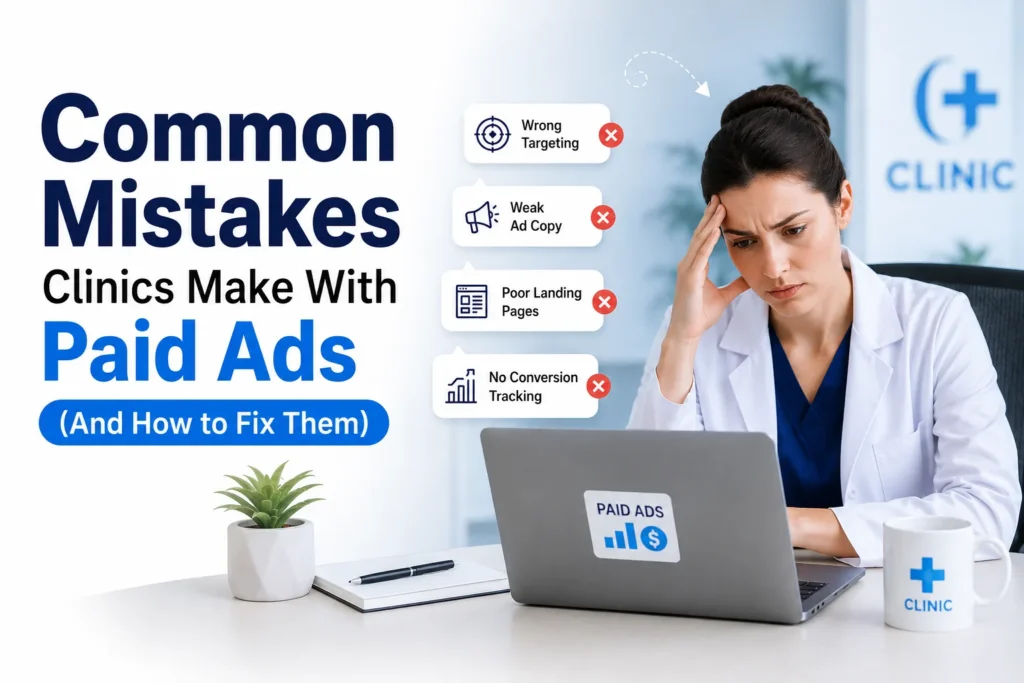
Quick Summary Common mistakes clinics make with paid ads are: Targeting the wrong audience, Sending traffic to a weak homepage, Ignoring negative keywords. Common mistakes clinics make with paid advertising cost clinics thousands in wasted spend before they even know what went wrong Most clinics run ads without a clear cost per booked appointment benchmark, making scale impossible. Google Ads for dental clinic campaigns fail most often due to broad match keywords and zero landing page alignment. Clinic ads in 2026 must be built for Google AI Mode, not just traditional blue link results. Fixing these mistakes does not require a bigger budget; it requires a smarter campaign structure. You set a budget. You launch the campaign. Clicks come in. But the phone barely rings, and bookings stay flat. Sound familiar? This is exactly where most beauty and dental clinics find themselves after their first, second, or even third attempt at paid advertising. The problem is rarely the platform. Google Ads and Meta Ads work. The problem is the execution. And the mistakes are far more predictable than most clinic owners realize – we broke down several of the same failure patterns in Why Most Dental Clinic Ads Fail (And How to Fix Them). This blog breaks down the real reasons your paid ad budget is leaking and how to plug every hole. Why Most Clinics Waste Money on Common Mistakes in Paid Advertising The number one reason clinics burn through their budget is they treat paid ads like a poster on a notice board. You put it up and hope the right person walks past. That is not how paid advertising works in 2026. Every rupee or dollar you spend on ads is an auction bid against competitors who may be spending smarter, not more. When clinics run generic campaigns, they often miss key elements. If there’s no defined patient persona, no intent segmentation, and no clear cost per booked appointment goal, the campaign may run but will likely fail commercially. The fix starts before you open Google Ads or Meta Ads Manager. It starts with clarity: who is searching, what are they ready to do, and what do they need to see before they call. The Common Mistakes Clinics Make With Paid Ads That Kill ROI 1. Targeting Too Broad and Wasting the Entire Budget Bidding on terms like “skin treatment” or “dentist near me” without adding location modifiers, intent filters, and negative keywords is one of the most common and expensive mistakes clinics make with paid ads. These terms attract browsers, not bookers. Your ad shows to people who are curious, not committed. The fix: build tight ad groups around high-intent, service-specific terms. “Laser hair removal Connecticut” converts. “Hair removal” does not. 2. Sending Paid Traffic to a Homepage Your homepage is designed for exploration. Paid traffic needs a destination designed for conversion. When a potential patient clicks your ad for a HydraFacial and lands on your general website homepage, the experience breaks. They have to find the service, the price point, and the booking option themselves. Most will not bother. Every ad group needs its own landing page that mirrors the ad message, answers the top objection, and has one clear call to action. 3. Ignoring Negative Keywords Entirely If your Google Ads for dental clinic campaign is running without a negative keyword list, you are paying for clicks from people looking for dental colleges, free dental camps, or jobs at dental clinics. None of them will ever book. Negative keywords are not optional. They are the difference between profitable campaigns and expensive ones – and they’re one of the first things we check in a quarterly Google Ads audit. 4. No Call Tracking or Conversion Setup Running paid ads without proper conversion tracking is the equivalent of spending on a sales team and never tracking how many deals they close. In 2026, Google’s AI bidding (Smart Bidding) needs conversion data to optimize. Without it, Google’s algorithm has nothing to learn from. It will waste your budget on what seems like engagement, not what actually drives bookings. 5. Setting the Campaign Once and Leaving It Campaigns left on autopilot deteriorate. Competitors change bids hourly. Search intent shifts seasonally. A campaign that performed well in January needs adjustments by March. Clinic owners who set and forget their Google Ads campaigns end up overpaying for increasingly low-quality traffic as the weeks pass. Common Mistakes Clinics Make With Paid Advertising on Meta and Instagram Meta advertising for clinics comes with its own set of failure patterns. The biggest mistake is running awareness-level creative assets at the bottom of the funnel. Beautiful before-and-after videos build trust over time. However, they don’t book appointments by themselves. Clinics need a funnel. Start with awareness content at the top. Then, include testimonials and social proof in the middle. Finally, make a direct offer with urgency at the bottom. Another frequent error is targeting “interest-based” audiences without retargeting layers. If someone visited your website but did not book, they are your warmest audience. Clinics that are not running retargeting campaigns are losing their hottest prospects to competitors who are. Google Ads for Dental Clinic Campaigns: What 2026 Actually Requires 1. Aligning Ads With Google AI Mode Google AI Mode in 2026 uses query fan out, meaning one search generates multiple related searches behind the scenes. Your content and ads need to cover the full cluster of intent around a service, not just one keyword. For dental clinics, your landing page for implants should cover cost, recovery, alternatives, and longevity. This is important because Google’s AI seeks the most complete and trustworthy answers. 2. Local Service Ads Alongside Search Campaigns Most dental clinics rely entirely on Search campaigns and miss Google Local Service Ads entirely. Local Service Ads appear above everything else in the results page and carry Google’s verification badge. For a dental or beauty clinic competing in your area, this placement is often underused and cheaper than typical search spots. 3. Budget
Top Dental Clinic Marketing Trends in 2026
The dental industry across the United States is becoming more competitive every year. Patients no longer choose clinics based only on location. They compare reviews, search treatment information online, watch videos, and expect fast communication before booking appointments. This shift has completely transformed dental clinic marketing trends in 2026. Today, clinics that rank higher on Google and appear in AI-generated search summaries are attracting more patients consistently. Modern dental marketing focuses on visibility, trust, patient experience, and content quality. This blog explores the biggest trends helping dental practices grow faster in the US market and explains how clinics can stay ahead online. Why Dental Clinic Marketing Trends Is Changing Fast in 2026 Google search behavior has changed significantly. Patients now search using detailed questions instead of simple keywords. Examples include: Best cosmetic dentist near me Affordable Invisalign treatment in Dallas The emergency dental clinic is open today Google AI Overviews now summarizes search results directly on the search page. Clinics with helpful content, strong reviews, and optimized websites appear more often in these AI results. This makes dental clinic marketing trends more important than ever before. Clinics that focus on SEO, local search, and educational content are seeing more visibility and attracting more patients in 2026. Best Dental Marketing Services Clinics Are Using Today 1. Local SEO Local SEO continues to dominate patient acquisition for dental clinics across the U.S. Important local SEO factors include: SEO Factor Why It Matters Google Business Profile Improves map rankings Patient reviews Builds trust Local keywords Increases visibility Mobile optimization Improves user experience Professional dental marketing services now prioritize hyperlocal visibility. For exceptional regional reach, partnering with Marketing A Clinic ensures your practice dominates local search results, attracting nearby patients actively seeking care. 2. AI Optimized Website Content Google AI rewards websites providing direct, clear, and trustworthy answers. Modern clinic websites focus on structured data. This helps their clinical expertise rank well in search engines. Modern clinic websites now include the following: FAQ pages Treatment guides Educational blogs Structured service pages Implementing these structured formats dramatically improves traditional SEO rankings. This strategy helps your content stand out. It grabs key spots in AI search results effectively. 3. Video-Based Marketing Short-form video content has become a premier patient conversion tool. Visual storytelling eases anxiety. It makes complex treatments feel familiar and accessible to local audiences. Popular video formats include: Smile transformation stories Dentist introductions Treatment walkthroughs Patient testimonials Publishing high-quality video content builds deep psychological trust. Consistent digital engagement strengthens your brand credibility. This, in turn, boosts high-value appointment inquiries and patient consultations. 4. Reputation Management Recent Statista data for 2026 shows a projected $107 billion spent worldwide on digital brand trust and content systems. This highlights how much patient choices depend on online credibility. Modern dental marketing services help clinics: Generate positive reviews Respond professionally to feedback Improve online reputation Increase patient trust signals Systematically managing patient reviews transforms your digital presence. Addressing local feedback helps your clinic build a trusted brand. This way, casual searchers turn into committed patients. 5. Hyper-Personalized Patient Remarketing Paid digital advertising now focuses on hyper-targeted patient remarketing campaigns. Advanced automation tools re-engage users who previously visited your treatment pages. Tailored Ads: Displays specific treatments users viewed. Custom Reminders: Prompts users to complete bookings. Segmented Campaigns: Separates new leads from existing patients. Privacy Compliance: Utilizes first-party data securely. Higher ROI: Minimizes wasted ad spend significantly. 6. Voice Search Optimisation Patients increasingly use smart assistants like Alexa and Siri to find urgent dental care nearby. Content must be optimized for natural, conversational phrasing rather than rigid keywords. Conversational Content: Matches natural human speech patterns. Long-Tail Keywords: Targets full, spoken question phrases. Urgent Care Queries: Optimizes for “near me” emergency searches. FAQ Integration: Feeds answers directly to voice devices. Quick Answers: Focuses on immediate, snackable information. Optimize your clinic voice search strategy now to capture immediate local emergencies. Connect with us to implement conversational patient acquisition systems that maximize your clinical bookings today. How AI Search Is Reshaping Dental Clinic Marketing Trends Google’s AI search results in 2026 are reducing clicks to low-quality websites. Only authoritative and helpful content performs well now. If your clinic’s content is not structured to be referenced by Google’s AI overview, you are invisible to a large portion of high-intent searchers before they ever scroll. Here is what your dental clinic marketing trends must focus on to rank in AI search results: 1. Helpful Educational Content Patients want clear answers written in simple language without medical jargon. Explaining treatments like implants, root canals, and aligners in simple terms builds trust. It also helps your clinic appear more in AI searches. 2. Structured Website Content That AI Can Read Easily Clear headings and well-organized information improve how Google’s AI reads and references your website. Clinics with well-structured pages rank higher in AI-generated overviews. This is better than competitors who have messy, text-heavy sites. 3. Trust Signals Google prioritizes clinics with strong reviews, updated websites, consistent branding, and verified local information. These four trust signals impact whether your dental clinic marketing appears in AI search results. 4. Conversational Search Optimization for Voice Queries Patients increasingly use voice search to find dental care. A successful dental clinic marketing approach now uses natural phrases like “which dentist near me accepts walk-ins?. ” This is better than robotic keyword strings that feel unnatural. The Dental Marketing Strategy That Converts Visitors Into Patients Getting traffic is one problem. Turning that traffic into confirmed bookings is a completely different challenge. The average dental clinic website converts at just 3%. If yours is above 5.4%, you are doing well. Above 10% means your conversion system is exceptional. A high-converting dental marketing strategy is built on three pillars: Pillar 1 – Trust Signals That Reduce Patient Anxiety Clients, especially those new to cosmetic or high-value treatments, feel apprehensive before their first visit. Your website and social media must do the emotional work of reducing that anxiety before they call. Patient video testimonials, before-and-after treatment
Google Ads vs Meta Ads for Dental Clinics: Which Gives Better ROI?
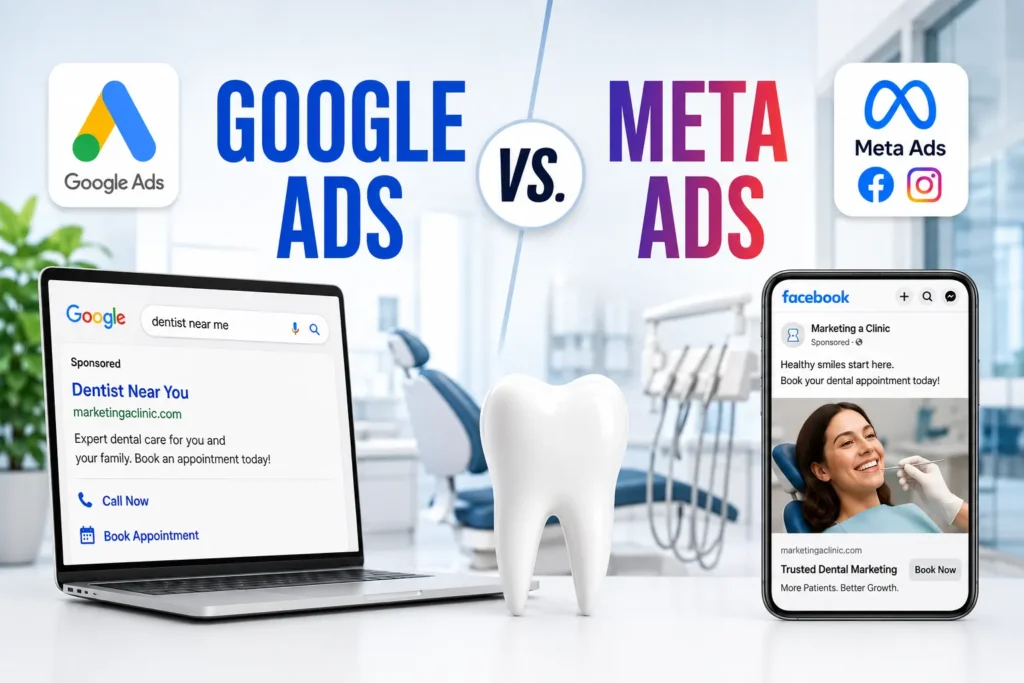
Quick Summary Google Ads vs Meta Ads: Google wins for ready-to-book patients; Meta wins for building awareness on undecided treatments-the best strategy uses both. Google Ads for dental clinics drives faster bookings by capturing patients who are actively searching and ready to take action. Meta Ads supports awareness and retargeting, making it effective for cosmetic treatments where interest needs to be built. The best dental clinic digital marketing strategy matches each treatment with the right platform based on patient intent. Google works best for emergency and clinical services, while Meta performs better for visual and elective treatments. Combining both platforms creates a full patient journey from discovery to booking, improving overall ROI. Tracking conversions, using proper landing pages, and retargeting are essential to avoid wasted ad spend. Every dental clinic marketing budget faces the same question: where should the money go? Google Ads for dental clinics and Meta Ads for dental lead generation are the two main paid channels. However, they operate on completely different psychological principles. Choosing the wrong one for the wrong treatment type can waste your budget and produce no measurable return. This guide cuts through the generic “use both” advice. What follows is a category-by-category breakdown, real cost-per-lead benchmarks sourced from 2026 industry data, and a strategic framework for dental clinic digital marketing that actually moves the needle on impressions, clicks, and qualified traffic. Which Ad Platform Should a Dental Clinic Use: Google or Meta? The single biggest mistake in dental clinic digital marketing is treating Google and Meta as interchangeable. They are not. Search engines capture existing demand. Social platforms manufacture demand. Understanding this distinction determines where every dollar in your paid media budget should go. When Google Search Ads win A patient who types “emergency dentist open now” or “tooth extraction near me” has already decided they need treatment. They are in purchase mode. Google Ads intercepts this moment precisely before the patient clicks on a competitor. For high-intent, high-urgency services, no other paid channel competes with Google Search’s reach and conversion efficiency. When Meta Ads win A patient scrolling Instagram has not typed a query. They have not yet decided they need veneers or Invisalign. But a well-designed before-and-after creative, delivered to the right demographic, can plant that thought. Meta Ads for dental lead generation catch the eye by interrupting the scroll. They feature a strong visual proof point that grabs the attention of a passive audience, making them curious about cosmetic upgrades. The framework is simple: link each treatment you want to promote to its main search mode. If it is something patients search when in pain or urgency, that is a Google Ads keyword. If it is something that requires visual persuasion and aspiration, that is a Meta creative brief. Google Ads vs Meta Ads for Dental Clinics: What Actually Makes Them Different? Google Ads vs Meta Ads is not about which platform is better. It is about which one matches your treatment type and patient intent. Metric Google Search Ads Meta / Facebook Ads Avg. CPC $7.85 $3 – $5 Avg. CPL $83.93 $45 – $90 Avg. CTR 5.44% 1.3% – 1.8% Conversion Rate 9.08% 4.6% – 7.0% Best For Emergency, clinical, high-intent Cosmetic, elective, visual Lead Quality Very High Medium Retargeting Moderate Excellent According to Google Ads Benchmarks by Industry (WordStream / LocaliQ, 2025–2026), the healthcare and dental sector sees an average CPC of $7.85, one of the highest across all industries, reflecting how competitive patient acquisition has become in search. Google Ads wins on conversion quality, as patients searching right now are ready to act. Meta Ads win on cost efficiency and visual reach, making them the stronger choice for cosmetic treatments where desire needs to be built before a decision is made. Which Platform Gives Better ROI for Dental Clinics: Google Ads vs Meta Ads? For immediate revenue, Google Ads for dental clinics wins. For long-term growth and patient nurturing, Meta Ads fills the funnel above it. Google Ads works at the bottom of the funnel. It captures patients who are already searching, already decided, and ready to book. Meta Ads works at the top and middle stages. It builds awareness for treatments patients have not yet considered and retargets those who showed interest. Where each platform lives in your funnel: Google Ads → Bottom funnel – high intent, ready to book, direct conversion. Meta Ads (Top) → Awareness – cosmetic treatments, smile makeovers, Invisalign discovery. Meta Ads (Middle) → Retargeting – re-engage visitors who clicked but did not book. The clear verdict: If you have a budget for only one, start with Google Ads. It generates revenue faster. If you are scaling, use both platforms together. Google captures demand while Meta builds and recaptures it. The strongest dental clinic digital marketing strategies do not treat these platforms as competitors. They treat them as two connected stages of the same patient journey. Google brings patients in, Meta keeps your clinic in their mind until they book. How Does a Patient Go from Seeing an Ad to Actually Booking a Dental Appointment? Understanding the full patient journey from first exposure to conversion helps you see exactly where Google and Meta fit into your strategy. 1. Discovery: The First Touch A patient either searches on Google or comes across your clinic through an ad on Meta platforms. When someone is looking for urgent or clinical treatments, Google is where they act. For cosmetic treatments, Meta helps introduce the idea and bring your clinic into consideration. Both platforms play a role, but using the right one for the right treatment makes all the difference. 2. Validation: The Trust Check After clicking your ad, the patient starts evaluating your clinic. They look at your Google reviews, before and after photos, website clarity, pricing signals, and overall credibility. This is where most clinics lose conversions. It is not about being the closest option. It is about being the most trusted option. Strong trust signals increase conversion rates and reduce your cost