SEO vs Google Ads for Clinics: What Works Better?
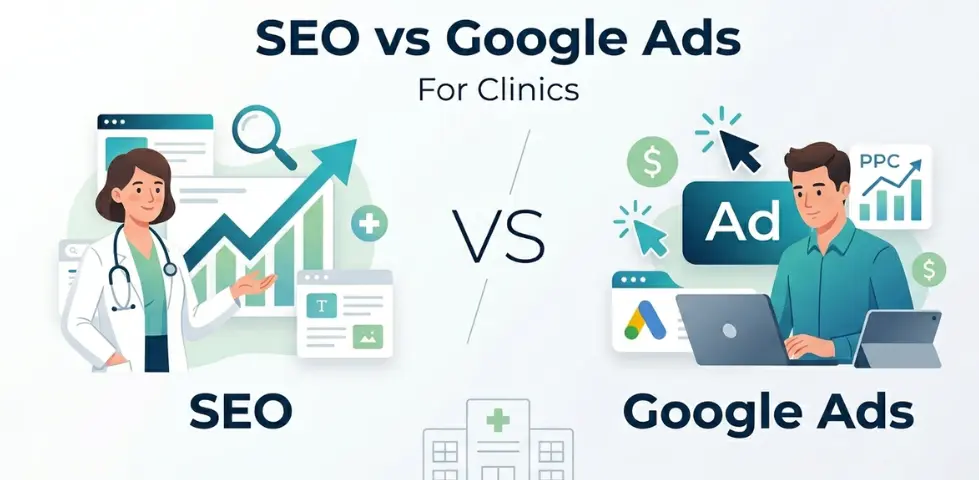
If you’re deciding between SEO vs Google Ads for clinics, the right answer depends on how fast you need patients and how you want your marketing to perform over the next three to five years. Google Ads can bring leads this week. SEO can bring patients consistently without paying for every click. The real question is not which is better. Which one gives your clinic stronger, more stable returns?
Clinic owners across the U.S. are dealing with rising ad costs, stronger local competition, and patients who research more before booking. This guide breaks down dental SEO vs PPC, real cost comparisons, ROI scenarios, and what the best marketing strategy for clinics looks like today.
What Is the Difference Between SEO and Google Ads for Clinics?
SEO helps your clinic appear in organic search results when patients search for services like “dentist near me” or “Botox clinic in Miami.” You do not pay per click. Instead, you invest in improving your website, local listings, and authority.
Google Ads places your clinic at the top of search results immediately. You pay each time someone clicks.
The difference is simple:
| Feature | SEO (Search Engine Optimization) | Google Ads (PPC) |
| 1. Results Speed | Long-term: Takes 3–9 months to see significant patient bookings. | Instant: Your clinic appears at the top the moment the campaign is live. |
| 2. Cost Structure | Fixed/Investment: You pay for strategy and content, not for clicks. | Pay-Per-Click (PPC): You pay Google every time a potential patient clicks. |
| 3. Placement | Organic Results: Appears in the main list and the “Google Maps 3-Pack.” | Sponsored: Appears at the very top and bottom labeled as “Ads.” |
| 4. Trust Factor | High: Patients often perceive organic results as more credible and “earned.” | Moderate: Some patients skip ads to find “natural” local recommendations. |
| 5. Continuity | Permanent: Rankings remain even if you pause your marketing efforts. | Temporary: Traffic stops the second your daily budget runs out. |
| 6. Targeting | Broad/Local: Focuses on keywords like “dentist near me” or “best clinic.” | Laser-Focused: Target by specific procedure, zip code, age, and time of day. |
| 7. Maintenance | Content-Heavy: Requires regular blog posts, reviews, and technical updates. | Data-Heavy: Requires daily monitoring of bids, keywords, and ROI. |
| 8. Long-term ROI | Higher: Cost-per-patient decreases significantly as organic traffic grows. | Stable but Linear: Cost-per-patient stays relatively flat as you scale. |
According to Google Economic Impact reports, businesses make an average of $2 in revenue for every $1 spent on Google Ads. However, that return depends heavily on campaign setup and conversion tracking.
On the SEO side, BrightEdge research shows that organic search drives 53% of all website traffic across industries. For clinics, this often means long-term patient acquisition without ongoing click costs. That is the core of paid ads vs organic traffic.
How Fast Do SEO and Google Ads Deliver Results?
Google Ads can generate leads within days. Once your campaign is live, your clinic appears for targeted keywords. This is the classic long-term vs short-term marketing decision for immediate impact.
SEO takes time. Most clinics see meaningful movement within 3 to 6 months, depending on competition and local SEO ranking factors. This is a crucial part of your clinic marketing budget allocation for the future.
Here is the clear comparison:
| Factor | SEO for Clinics | Google Ads for Clinics |
| Time to Results | 3–6 months | Immediate |
| Traffic Type | Organic | Paid |
| Cost Structure | Fixed monthly investment | Pay per click |
| Long-Term Impact | Compounds over time | Stops when budget stops |
If you need bookings this month, ads help. If you want predictable growth next year, a dental marketing ROI comparison shows that SEO matters more.
Cost Breakdown: What Are Clinics Really Paying?
Cost Per Click for Dental Keywords
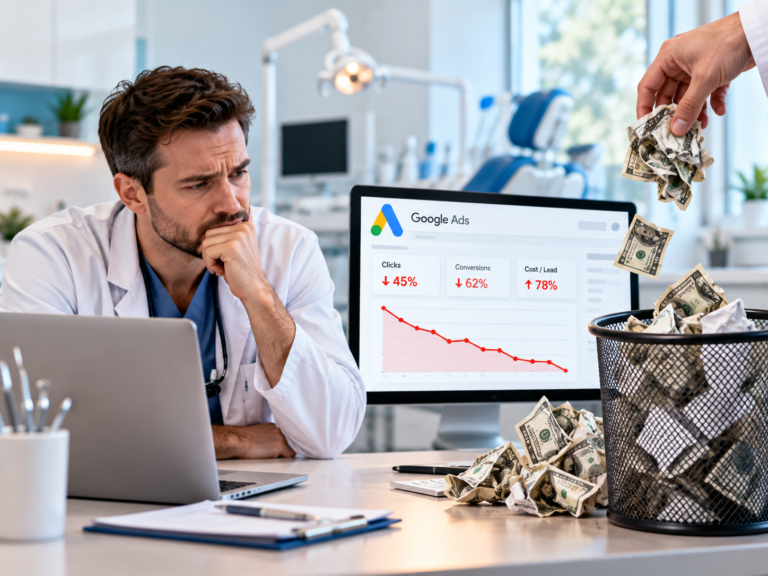
Dental keywords are highly competitive, with costs often exceeding $25 per click in major cities. Without a strong Return on Ad Spend (ROAS), 100 clicks can quickly cost $3,000 without guaranteeing any new patient bookings.
When evaluating SEO vs Google Ads for clinics, remember that paid search requires constant funding. High-intent terms like Invisalign drive up costs, making organic strategies essential to lower your overall long-term cost per acquisition.
SEO Investment Costs
SEO requires a monthly investment of $1,500 to $4,000, but it eliminates the “pay-per-click” tax. Unlike ads, organic rankings build permanent authority. Over time, this compounding visibility significantly improves your dental marketing ROI comparison by lowering the long-term cost of every new patient lead.
Which One Drives Customers Faster: SEO vs Google Ads for Clinics?
Google Ads for clinics bring in patient inquiries faster than SEO. Your practice shows up at the top of search results right after you launch a campaign. This is especially true for urgent or high-intent treatment searches.
Google Ads for Clinics
Google Ads delivers immediate visibility for clinics targeting urgent or service-specific searches. Your ads appear above organic results, placing your clinic in front of patients ready to book within days of campaign activation.
- Instant placement at the top of the search
- Target by service, city, and ZIP code
- Control the budget and daily spend
- Track calls, forms, and bookings
- Measure Return on ad spend (ROAS)
In the Google Ads vs SEO for dentists comparison, paid campaigns outperform in speed. If patient flow is slow this month, paid ads vs organic traffic is not equal—ads generate faster action.
SEO for Clinics
SEO takes longer because organic traffic growth depends on authority, relevance, and competition. Ranking for competitive clinical keywords can take months. However, once you achieve it, traffic comes without per-click costs. This boosts long-term marketing efficiency and stability.
Why You Need Both: A Smarter Strategy for Clinics
Complementary Strengths of SEO & Google Ads
The real advantage in the SEO vs Google Ads for clinics debate comes from integration, not selection. SEO builds long-term authority and trust, while Google Ads captures demand the moment a patient searches. Together, they balance visibility with stability.
According to Google Economic Impact data, businesses make an average of $2 in revenue for every $1 spent on Google Ads. At the same time, BrightEdge research shows that organic search drives over 50% of website traffic across industries. That combination explains why relying on only one channel limits growth potential.
When to Use Google Ads to Support Organic Growth
A strong growth model uses Google Ads to generate patient volume while SEO foundations are strengthening. This protects short-term revenue while organic rankings mature. Once SEO performance improves, budgets can shift toward expansion rather than competing repeatedly for the same high-cost keywords.
This staged approach allows clinics to allocate their marketing budget more effectively. Paid campaigns generate immediate bookings, and SEO adds value over time.
Leveraging Paid Search Data to Prioritize SEO Content
Google Ads provides real-time conversion insights through search query reports and keyword-level data. This information reveals which services, treatments, and patient intents generate booked appointments—not just clicks.
Using this data to guide SEO content planning reduces guesswork and strengthens execution. It creates alignment between paid ads vs organic traffic efforts and improves overall dental marketing ROI comparison accuracy.
Budget Allocation Across Short-Term and Long-Term Goals
High-performing clinics treat marketing budgets as strategic levers. The early-stage practices use paid search as their main advertising method, while established clinics use SEO after their websites reach stable search engine rankings.
A typical performance mix puts about 60–70% into SEO efforts and 30–40% into paid campaigns. It then shifts as efficiency metrics change. This flexible model reflects the best marketing strategy for clinics focused on both resilience and growth.
Realistic ROI Expectations
Setting proper expectations prevents frustration later. SEO typically begins generating noticeable ROI within six to twelve months, and its impact compounds over time as authority strengthens.
Google Ads can show results right away. However, to be effective, you must continuously optimize, improve your landing pages, and manage costs. When clinics know these timelines, the choice between SEO and Google Ads becomes strategic, not reactive.
Final Verdict: SEO vs Google Ads for Clinics
There is no single winner between SEO vs Google Ads for clinics. If you need patients this week, Google Ads delivers immediate results. However, for predictable growth and a reduced cost per acquisition over time, SEO builds the essential foundation for your clinic’s long-term success.
The best marketing strategy for clinics is data-driven, not opinion-driven. We look at competition and local demand. This helps us optimize your clinic’s marketing budget and boost your dental marketing ROI. Ready to scale? Book a free 30-minute strategy call with our experts today!
Frequently Asked Questions
Q1. Is SEO better than Google Ads for dentists?
SEO provides long-term organic visibility. Google Ads delivers faster short-term leads. Most dental practices benefit from combining both.
Q2. How much should a clinic spend on marketing?
Most clinics invest 5% to 10% of annual revenue into marketing. New clinics may need higher early investment for visibility.
Q3. What is the average cost per click for dental keywords?
In many U.S. markets, dental keywords range from $8 to $35+ per click depending on competition and city size.
Q4. How long does SEO take to work for clinics?
Clinics typically see measurable results within 3 to 6 months, with a stronger impact after 9 to 12 months.
Q5. Which has better ROI: Dental SEO vs PPC?
Over time, SEO often produces lower acquisition costs. PPC generates faster returns but requires ongoing spend.