ChatGPT vs Google search for clinics: Where Are Patients Actually Finding Clinics in 2026?
What This Blog Covers
- ChatGPT vs Google search for clinics and the real data behind where patients are searching in 2026
- Why AI produces a zero-click shortlist of two to three providers and makes every other clinic invisible
- How ChatGPT and Google AI Overviews differ in the trust signals they use to recommend a clinic
- What the search intent split means for dental patient search behavior in 2026 and which channel wins each type
- Why dental practices are losing patients to AI search without a single analytics report flagging the loss
- The generative engine optimization steps every clinic needs to take before 2027 patient behavior fully matures
Healthcare discovery used to start with a search. It now starts with a question. That one sentence captures the most important shift happening in clinic marketing right now, and most clinic owners have not acted on it yet.
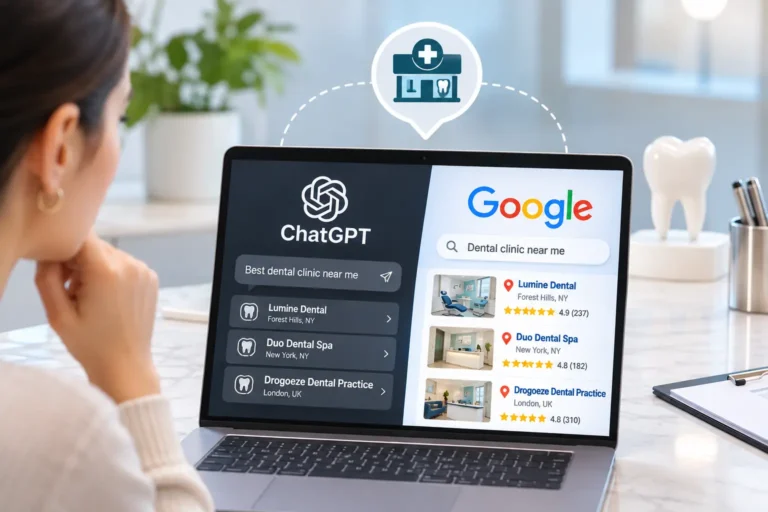
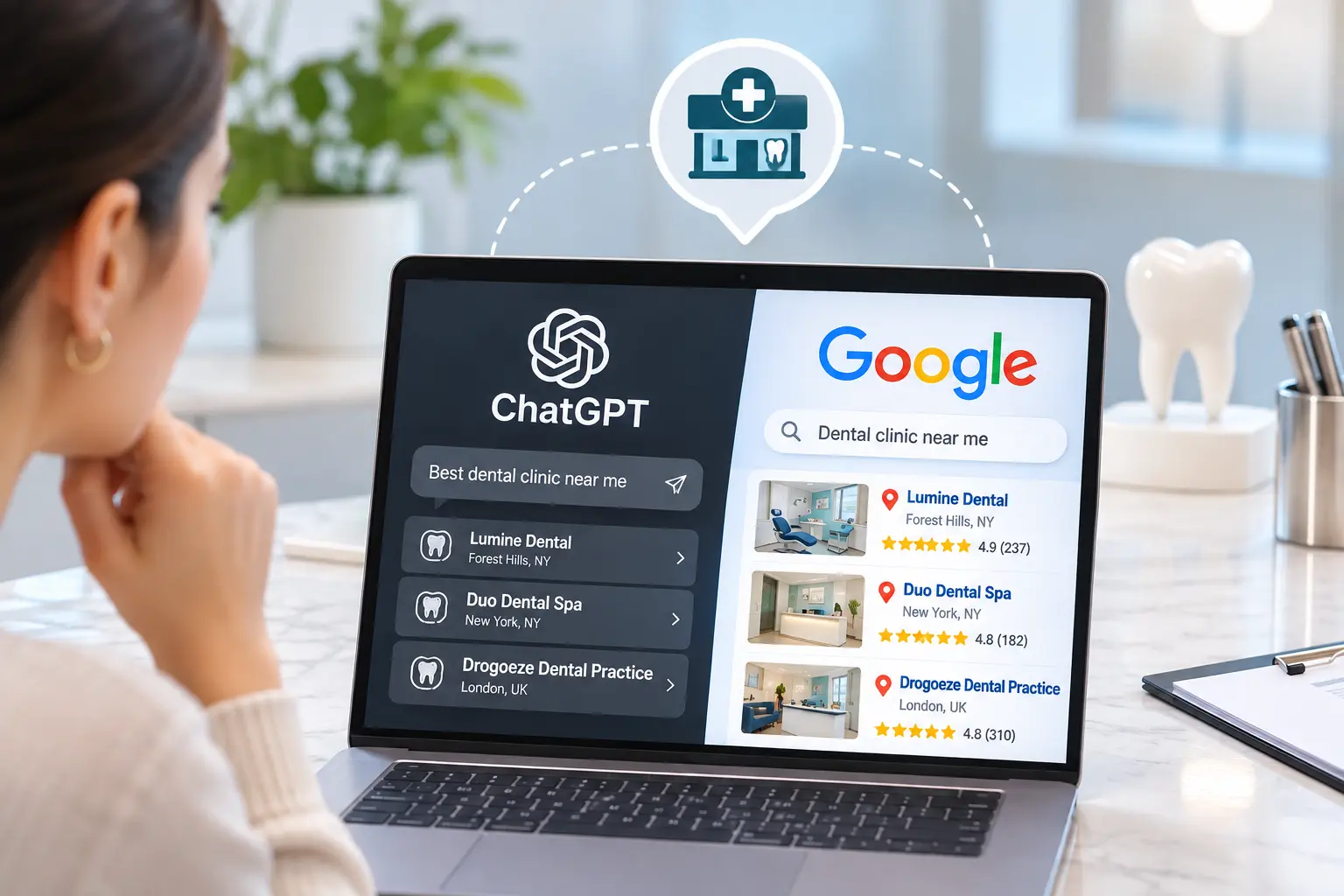
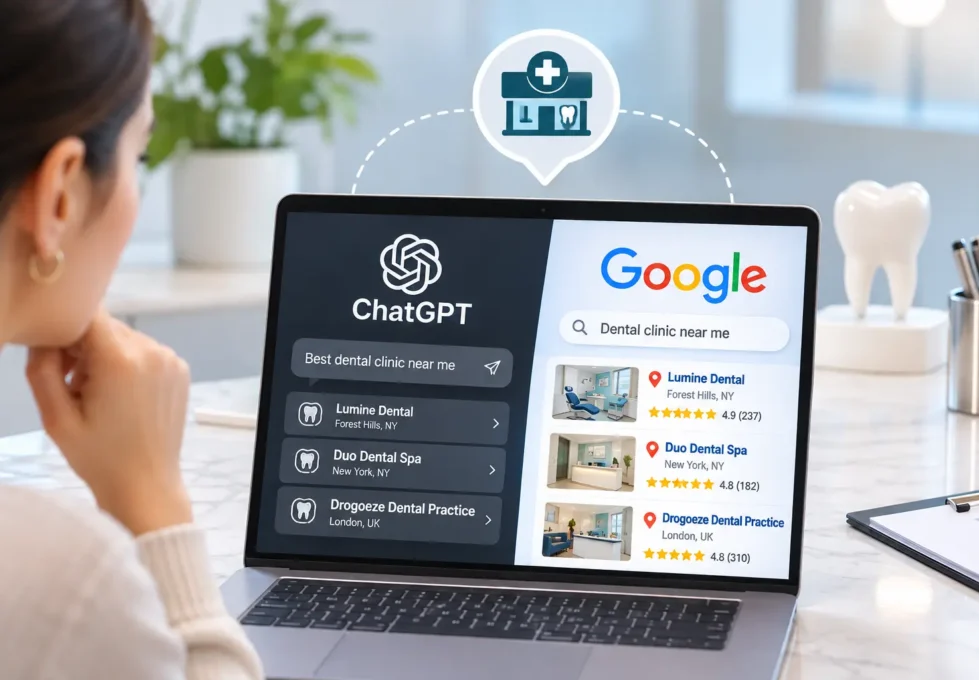
A search produces a list. Twenty clinics appear; the patient clicks, reads, compares, and decides. Your clinic had multiple chances to be seen. A question asked to ChatGPT produces an answer. One paragraph. Two or three named providers. The patient reads it and either calls or asks for a follow-up. Every other clinic in your city just disappeared from that patient’s consideration.
ChatGPT vs Google search for clinics is not a future concern. In 2025, 32% of patients used AI tools to research a new healthcare provider for the first time. By mid-2025, 26% said AI directly influenced which provider they chose. AI Overviews now appear in more than 82% of health-related searches. If your clinic is visible on Google but invisible to AI, you are already losing patients you will never know you lost.
ChatGPT vs Google Search for Clinics: How Patient Discovery Has Structurally Changed
The old patient journey was linear. Search, click, read reviews, call. The 2026 patient journey is non-linear and AI-mediated. Patients now move across Google, AI chatbots, and review platforms in the same research session, often getting their final recommendation inside an AI interface before they ever visit a website.
Zocdoc’s 2025 What Patients Want Report looked at over one million bookings. It found that 1 in 3 Americans use ChatGPT or another AI tool for health advice each week. Separately, 73% of patients under 35 now start their healthcare search on AI platforms rather than a traditional search engine. These are not early adopters. This is mainstream patient behavior heading into 2027. That is why ChatGPT vs Google search for clinics is now a core marketing question, not a tech curiosity.
The Yext analysis of 6.8 million AI citations across ChatGPT, Gemini, and Perplexity found something clinic owners need to understand clearly. AI tools do not cite clinic websites first. They cite structured directories like Zocdoc, Healthgrades, and Vitals. The front door to healthcare in 2026 is an AI conversation, and AI has already chosen its sources. Clinics that are not present and well-structured in those directories are invisible to a generation of patients who will never open a search results page.
The Numbers That Matter
40 million people ask ChatGPT health questions every day. Four numbers explain why ChatGPT vs Google search for clinics matters right now: AI traffic to healthcare sites grew 527% year over year in 2025. Google AI Overviews appear on 82% of health-related searches. 90% of AI tool users trust the information nearly as much as advice from their own doctor.
ChatGPT vs Google AI Overviews: How Each One Decides Which Clinic to Show
ChatGPT and Google AI Overviews are not the same tool doing the same job, which is why ChatGPT vs Google search for clinics needs two different plans. They use various trust models, gather data from different sources, and cater to unique patient moments. Understanding which one to prioritize for your clinic depends on the type of patient you are trying to reach.
| Feature | ChatGPT for Clinic Discovery | Google AI Overviews |
| Trusted Sources | Institutional sites, government portals, and major healthcare directories. | Google Business Profiles (GBP), consumer brands, and hospital networks. |
| Best Query Type | Exploratory: Symptom analysis, specialist research, and treatment comparisons. | Transactional: Direct searches like “dentist open near me” or urgent bookings. |
| Patient Journey | Begins and ends inside the chat without opening external websites. | Displayed at the top of search results, reducing website click-throughs. |
| Primary Citations | Zocdoc, Healthgrades, Vitals, and Yelp. | Google Business Profile categories, reviews, and service details. |
| Integrations | Connects health records, wearable device data, and lab results. | Integrated with Google Maps and the local map pack for local intent. |
| Clinic Visibility | Recommends a shortlist of 2–3 clinics, excluding all other options. | Sits above organic listings; uncited clinics lose initial patient contact. |
What Percentage of Patients Now Use AI to Find a Doctor
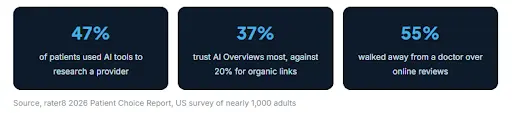
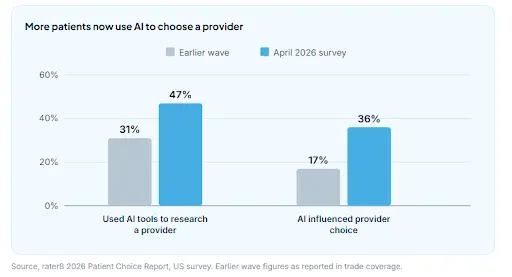
AI is quietly changing how people choose doctors, and the numbers prove it. The patient choice report 2026 by rater8 surveyed nearly 1,000 US adults. It found that 47% of patients have used tools like ChatGPT or Google AI Overviews to research a provider. Nine months earlier, that figure was 31 percent.
So how many patients use AI to choose a healthcare provider? Among people who looked for a doctor last year, 36% said AI influenced their choice. This is slightly more than those who relied on Google searches at 34% and doctor referrals at 32%. That is a clear snapshot of how patients choose a doctor 2026, and AI now sits at the top of the list. Surprisingly, 64% of patients aged 45 to 60 use AI for this, against 28 percent of those aged 18 to 29.
Patients considering cosmetic or elective dental work can ask AI about costs, recovery times, credentials, and reviews all in one chat. A clinic that clearly shares this info on its website is easier for AI to recommend. But a vague homepage with no directory listing might not be mentioned at all.
These figures come from a US survey. Treat them as a direction of travel, not an exact benchmark for Indian patients.
Why Dental Practices Are Losing Patients to AI Search Without Seeing It in Their Data
A patient asks ChatGPT for the best dental clinic for nervous patients. It names a competitor, and the patient books. Your clinic sees no impression, no click, and no lost booking. That is exactly why dental patient search behavior in 2026 is so hard to measure.
- Google Analytics shows who visited your website, not who booked elsewhere after an AI shortlist
- Search Console and profile insights miss questions patients ask inside AI tools
- Ask new patients how they found you, naming ChatGPT, Google AI, and Perplexity
- Track the answers monthly to measure hidden demand
So how are patients finding dental clinics in 2026? Increasingly, through AI shortlists that leave no data trail. Is your dental practice invisible to AI search? Ask ChatGPT and Google for the best dentist in your area, then compare your rating and listing details with the clinics they name.
The invisible problem: Google tells you which patients clicked your website. AI tools tell you nothing. The patients who have got a competitor recommendation never appear in your data at all. That gap is growing every month.
How Clinics Can Become Visible on Both Google and AI Search Before 2027
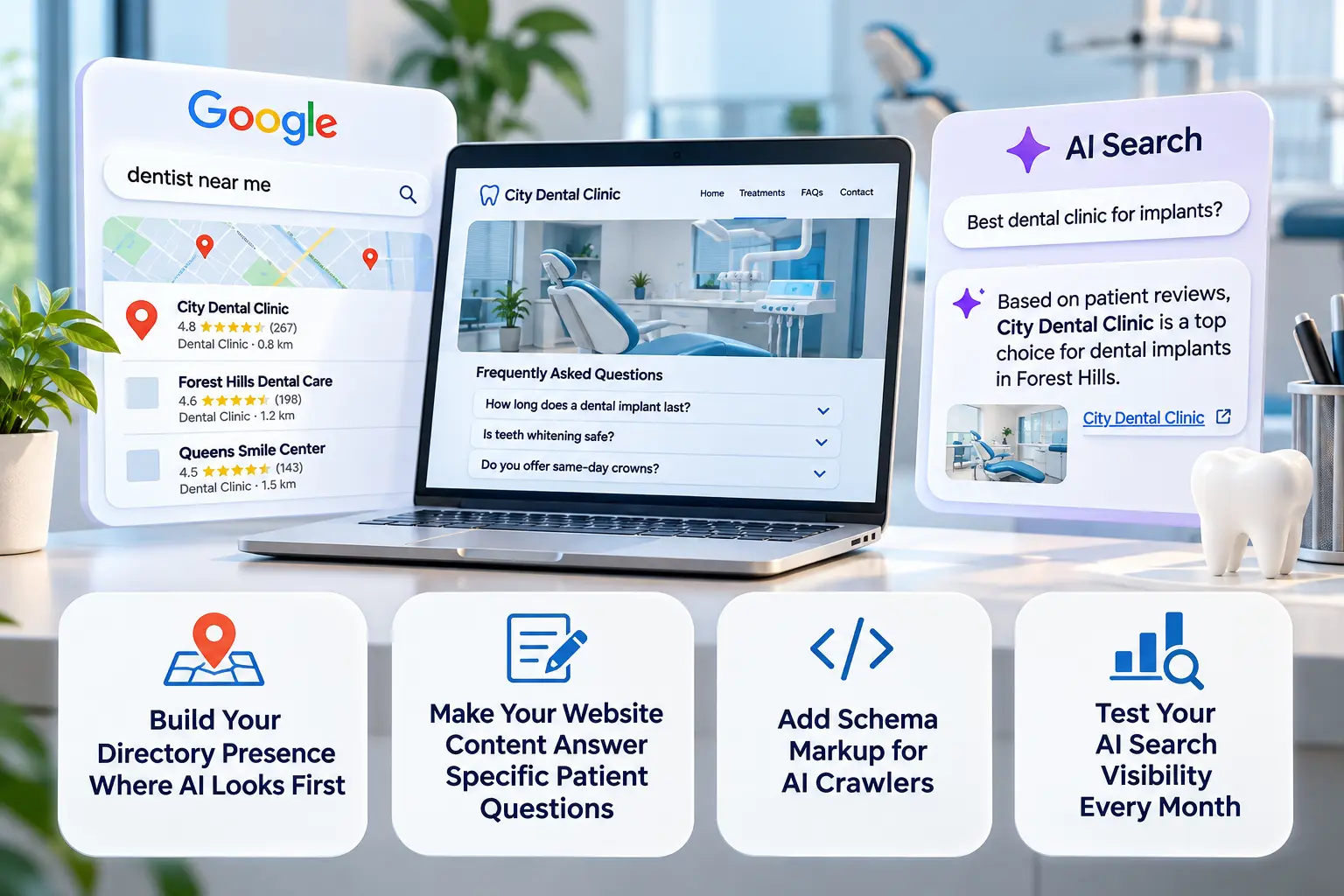
Generative engine optimization for clinics is not a replacement for local SEO. It is what you layer on top of it. The actions that boost your visibility to AI tools also help your Google Maps ranking. There are just a few extra steps in how large language models collect and evaluate information.
1. Build Your Directory Presence Where AI Looks First
Zocdoc, Healthgrades, and Vitals are where AI tools look first for clinic recommendations. A full, review-filled, real-time bookable profile on these platforms is now more crucial for AI discovery than your website. Get listed, keep your information accurate, and treat these profiles like your primary digital asset, not an afterthought.
2. Make Your Website Content Answer Specific Patient Questions
AI tools pull from websites during live searches and cite content that directly answers the question being asked. A service page that explains a procedure, shares a cost range, and describes what to expect performs much better in AI search than a promotional homepage. Write one clear answer per patient question. Keep it in the first 100 words of the section so AI can extract it without reading the full page.
3. Add Schema Markup for AI Crawlers
Schema markup with MedicalOrganization, Physician, and FAQPage types helps AI crawlers understand your clinic. It shows what your clinic is, its location, what you treat, and details about your practitioners. Without schema, AI tools have to infer this information, and they frequently infer it incorrectly or skip the clinic entirely. This is the highest-leverage technical action a clinic can take for AI search visibility in 2027.
4. Test Your AI Search Visibility Every Month
Open ChatGPT, Perplexity, and Google AI Overviews in a private browser window and ask the questions your ideal patient would ask. “Best dental clinic for implants in my city.” “Which skin clinic near me treats acne scarring?” “Anxiety-friendly dentist with evening appointments.” If your clinic does not appear, you have a visible, specific gap to close. Do this monthly, not once.
Final Words
The patient journey in 2027 starts with a question, not a keyword. Clinics that build for AI discovery now will hold a compounding advantage as adoption grows. Those that wait until AI search is impossible to ignore will find their competitors already named and trusted by the tools patients use most. The window to act early is closing, but it is still open.
At Marketing A Clinic, we audit your clinic’s visibility across Google search, AI tools, and healthcare directories. We show you exactly where patients are finding you and where they are finding your competitors instead, at no cost to you. Get Your Free AI Visibility Audit!
Frequently Asked Questions
Q1. Do patients actually use ChatGPT to find a clinic or doctor?
Yes. 31% of patients now use generative AI to research providers, and 1 in 3 Americans use AI health tools weekly.
Q2. Is ChatGPT replacing Google for medical searches in 2026?
Not replacing, but running alongside. Patients use Google for local urgent searches and AI for exploratory or specialist queries.
Q3. How does ChatGPT decide which clinic to recommend?
It pulls from structured directories like Zocdoc and Healthgrades first, then reviews, citations, and website content.
Q4. What percentage of patients use AI to choose a healthcare provider?
26% of patients say AI directly influenced which provider they chose, matching the influence of primary care referrals.
Q5. Why are dental practices losing patients to AI search?
AI names two to three providers and makes the rest invisible. Clinics with weak directory presence do not get mentioned.
Q6. What is generative engine optimization for clinics?
GEO is structuring your clinic’s directory profiles, website content, and schema so AI tools can find and cite you accurately.
Q7. How is ChatGPT different from Google AI Overviews for local clinic searches?
ChatGPT favors directories and major institutional sources. Google AI Overviews pull more heavily from GBP and regional brands.
Q8. How can I check if my clinic appears in ChatGPT or AI search?
Open ChatGPT or Perplexity in a private browser and ask the questions your patients would ask. Check monthly for changes.