
AI Search Optimization for Dental Clinics: Complete 2026 Guide
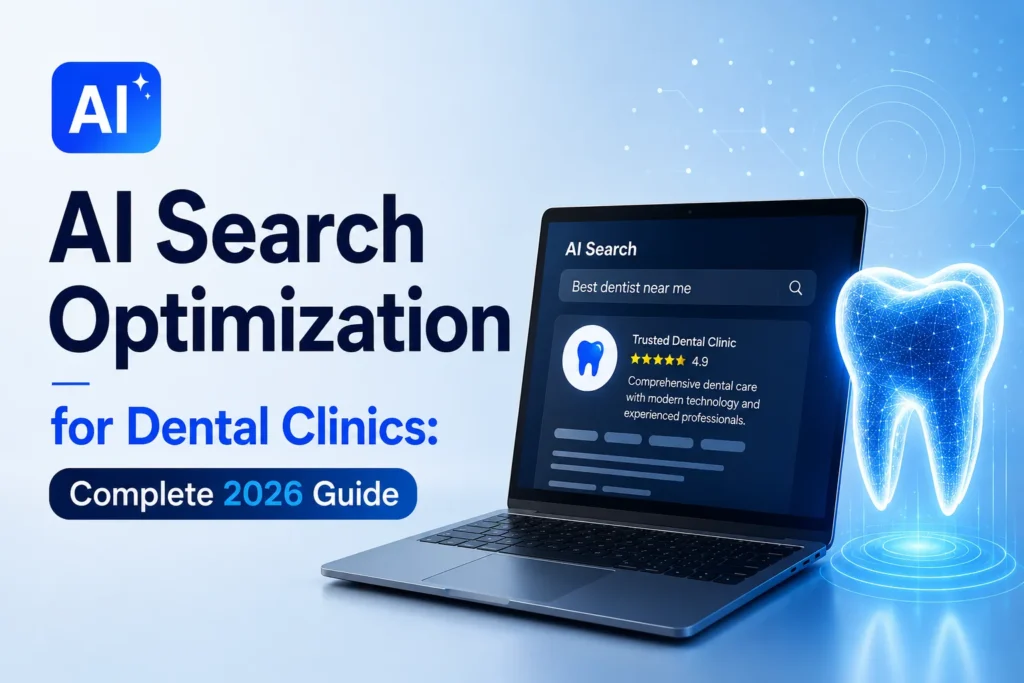
Google Search has changed dramatically in 2026. Patients are no longer scrolling through ten blue links before choosing a dentist. Many searches now display AI-generated answers, AI summaries, and conversational recommendations before users visit a website. For dental practices, this means traditional SEO alone is no longer enough. Clinics must optimize their websites so AI systems can easily understand, trust, and recommend their content. The clinics that appear in AI-driven search experiences gain more visibility, more trust, and more patient inquiries. That is why AI search optimization for dental clinics has become a critical marketing priority for 2026. What AI Search Optimization for Dental Clinics Actually Means in 2026 Traditional dental SEO in 2026 was about ranking a webpage at position one. AI search optimization is about getting your clinic cited inside an AI-generated answer. Those are two different outcomes, and they require two different approaches. When a patient searches for “best dental clinic near me 2026” on Google, the AI Overview at the top gathers details from reliable sources. It offers a clear recommendation. There is no scroll. There is no comparison. The AI names a clinic, and the patient calls. If that clinic is not yours, the visit never happens. 40%+ of all informational queries absorbed by Google AI Overviews before a click 90% of AI Mode responses feature established brands with structured data 97% of patients research dentists online before booking an appointment How does AI recommend dentists online? It uses authority signals such as your Google Business Profile, structured data on your site, the number and detail of reviews, and how well your content answers real patient questions. Clinics that check all those boxes get cited. Clinics that do not exist are invisible. How to Optimize Dental Clinic for AI Search in 2026: The Foundation Before you build any content strategy, three foundational signals need to be in place. These are what AI engines use to decide whether your clinic is credible enough to recommend. 1. Your Google Business Profile Is the AI’s Primary Source Your GBP is the single most referenced asset in AI local SEO dentist rankings. Your profile’s completeness and activity level decide if you show up in the Map Pack and AI Overview recommendations. Name, address, and phone must be identical across every directory Select all relevant categories, such as Dentist, Cosmetic Dentist, Dental Implants, and Orthodontist Upload clinic photos, staff photos, and procedure photos monthly Post weekly updates using service-specific language that your patients actually search for Enable the appointment booking link and keep your hours accurate in real time 2. Structured Data Tells AI What Your Clinic Does Dental website structured data is how you communicate directly with AI crawlers in a language they understand. Without it, even a quality website is hard for AI systems to understand and cite correctly. Add a Local Business schema with your clinic’s NAP details. Include DentistSchema if it’s available. Use FAQPage schema on each service page. Implement BreadcrumbList schema to show site hierarchy. In 2026, how dentists are winning with AI search comes down largely to this technical layer that most competitors are ignoring entirely. 3. Review Specificity Beats Review Volume A clinic with 200 generic five-star reviews will often lose in AI citations to a clinic with 100 reviews where patients specifically mention treatments like Invisalign, root canal, or teeth whitening. AI-generated dental recommendations are built from semantically rich review content. Encourage patients to write about the specific treatment they received, not just a generic “great experience.” AI Search Engine Optimization Guide for Dentists: Content That Gets Cited Content is where most dental clinics fall short in dental practice online visibility. Thin service pages with a list of treatments and a phone number do not get cited in AI answers. Content that directly answers specific patient questions does. 1. Build Question-First Service Pages Every service page should start with the most common patient question about that treatment. Then, provide a clear answer of 40 to 60 words right below the heading. This format mirrors how AI extracts snippets. For example, a dental implants page should open with “How long do dental implants last?” followed by a precise, factual answer before any other content appears. This is the core of how to rank dental practices on AI-powered search. AI does not reward pages that eventually get to the answer. It rewards pages that lead with the answer. 2. Target Local Search Intent With Hyper-Specific Content Local search intent for dentistry in 2026 is driven by urgency and specificity. Patients are not searching for a “dental clinic.” They are searching for “emergency dentist open Sunday in [City]” or “affordable dental implants in [Area].” Your content must match that specificity. Create dedicated pages for each treatment category, each patient concern, and each city or area you serve. A single generic “Services” page is invisible to AI. Ten specific, well-structured pages are citation-ready assets. 3. Use Voice Search Optimization for Natural Language Queries Voice search for dentists now accounts for a significant share of local dental queries, particularly on mobile. Voice queries are conversational: “Who is the best dentist near me for children?” Write FAQ sections in natural spoken language. Use complete questions as H3 headings. Give direct one-sentence answers before expanding. This is how top-rated dentist AI search answers are structured. Dental Clinic Search Ranking in Google AI Overviews: What the Algorithm Prioritises Understanding Google SGE dental results and how AI decides what to surface is not guesswork in 2026. The signals are consistent and documented. Here is how they stack up. Ranking Signal Weight in AI Citations What to Do Google Business Profile completeness Very High Fill every field, post weekly, add photos monthly Review volume and specificity Very High Ask for treatment-specific reviews and respond to every one Structured data markup High Add LocalBusiness and FAQPage schema to all pages Question-first content format High Lead every service page with a direct patient question and answer Page load speed under 100ms for AI
How Dental Clinics Can Dominate “Dentist Near Me” Searches Using AI SEO
Quick Summary Dentist near me searches have grown over 200% in the last five years, and the top three Google Maps results capture over 70% of all clicks. Local SEO for dental clinics now decides whether your practice appears in the Map Pack before a patient ever visits your website. AI search through ChatGPT, Gemini, and Perplexity is becoming a 4th discovery channel alongside Maps, organic search, and paid ads for finding a dentist. A genuine dental SEO agency builds your Google Business Profile, citations, and AI visibility together, not as separate, disconnected projects. Dental clinic marketing services built around real patient intent consistently outperform generic SEO tactics copied across every practice in a city. A patient with a sudden toothache does not browse ten dental websites. They search for dentists near me, glance at the first three results on the map, and call whichever one looks trustworthy and available right now. That moment happens thousands of times daily in Connecticut. It’s what local SEO for dental clinics aims to capture. 88% of patients search Google for dental services before booking, according to data from real dental practice campaigns. If your clinic is not visible at that exact moment, a competitor with stronger local SEO for dental clinics gets the call instead. This guide explains how to dominate dentist near me searches using AI SEO, and exactly what changed in 2026 that most dental marketing advice still ignores. What Does This Mean Dentist Near Me SEO What is the dentist near me SEO, and how does it work? It comes down to three signals Google evaluates every time someone searches. Relevance asks whether your practice matches the search. Distance measures how close you are to the searcher. Prominence measures how trusted and well-known you appear online through reviews, citations, and overall digital presence. At Marketing A Clinic, we generated high-quality leads for a dental client that helps dentists increase their ROI. This shows that “dentist near me” SEO works when done right from the beginning. How Do Dental Clinics Rank in Google Maps “Near Me” Searches Dental clinics rank in Google Maps “near me” searches mainly based on your Google Business Profile. For many general practices, the profile brings in more appointments than the website. Patients check hours, read reviews, and call directly from the listing. Why the Map Pack matters: The top three Google Maps results capture over 70% of all clicks for local searches. Businesses in the local 3-pack see 93% more calls and 126% more website traffic compared to those left out entirely. 1. Google Business Profile Optimization for Dentists Google Business Profile optimization for dentists starts with selecting accurate categories like “family dentist,” listing every treatment separately, and uploading real photos of your practice rather than stock images. 2. Local Citations for Dental Practices Consistent local citations for dental practices across Google, Yelp, and Healthgrades confirm your practice is legitimate. Even small mismatches like “Street” versus “St.” confuse Google and quietly hurt your ranking. 3. Reviews as a Ranking Signal Reviews now account for roughly 16% to 25% of local ranking authority for dental practices, second only to physical proximity. Ten recent reviews consistently outperform fifty reviews from two years ago. 4. Rise of AI Overviews in Google Search Google AI Overviews now answer many dental queries directly on the search results page before a patient ever sees the Map Pack. When someone asks “what’s the best dentist for same-day emergencies near me?” Google increasingly pulls a summarized answer that names one or two practices by name. If your Google Business Profile and website do not have clear, structured information about your specific services and credentials, you simply will not be one of the practices an AI Overview chooses to mention. 5. Voice Search Is Growing Patients are increasingly asking Siri, Alexa, and Google Assistant questions like “what is the highest-rated dentist open on Saturdays near me?” instead of typing a search. Voice queries are longer, more conversational, and almost always carry local intent. Practices that write natural, question-based content on their Google Business Profile and website, rather than short keyword phrases, are far more likely to be the answer a voice assistant reads back to a patient. Does AI SEO Help Dental Clinics Appear in Dentist Near Me Results Does AI SEO help dental clinics show up in “dentist near me” results? This is now a key question in dental marketing. A growing number of patients now ask ChatGPT, Gemini, or Perplexity to recommend a dentist before searching Google the traditional way. These AI tools do not show ten results. They summarise and often recommend one or two practices by name. You are either included in that recommendation, or you are not. AI SEO helps dental clinics get more patient bookings. The data shows that practices using AI-friendly content are recommended more often. Meanwhile, competitors with similar services miss out. Best Dental Marketing Agency for Local Search and Near Me Rankings Finding the best dental marketing agency for local search and near me rankings means looking past generic SEO packages built for any local business. A specialised dental SEO agency understands dental-specific search behaviour, treatment pages, and patient urgency in ways a general marketing firm does not. Discovery Channel What It Requires Google Maps 3-Pack Complete Google Business Profile, consistent citations, and steady recent reviews Organic search results Dedicated treatment pages, fast mobile site, and structured local content AI search recommendations Clear, structured information AI tools can extract and confidently recommend Dental Clinic SEO to Rank for Best Dentist Near Me on Google Maps To rank well for “best dentist near me” on Google Maps, a real dental clinic needs dedicated pages for each treatment. A single catch-all services page won’t work. Invisalign, implants, and emergency care each deserve their own page with specific local keywords. A dental marketing agency for Invisalign and implants near me searches and builds these pages around real patient questions, not generic copy. Dental Google Ads management works well
Dental SEO vs. Paid Ads: Which Gets More Patients Faster?
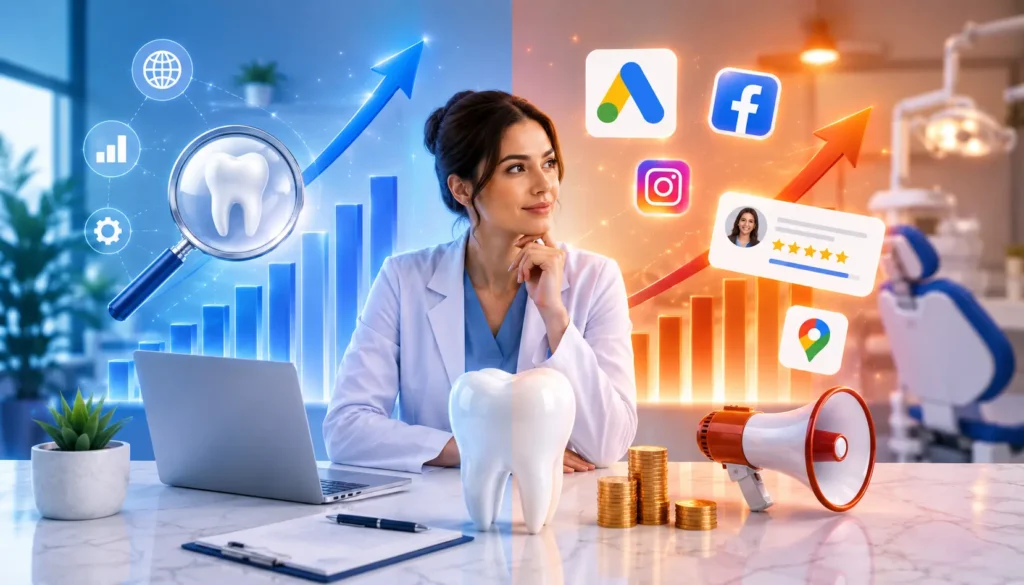
Every dental clinic owner hits the same wall eventually. You know you need new patients. You open Google and the two options stare back at you: run Google Ads for dentists and get traffic today, or invest in Dental SEO services and wait months for results. Pick wrong and you’ve burned your budget. Pick right and your appointment book fills up. The frustrating truth is that most advice online is written by agencies with something to sell. This blog has one goal: give dentists a clear, data-backed answer to the SEO vs PPC for dentists question so you can make the decision that fits your clinic, your timeline, and your budget. No guesswork. No jargon. What is Dental SEO? Dental SEO is the process of making your clinic appear in Google search results organically, without paying per click. When a potential patient types “dentist near me” or “teeth whitening in [city],” search engine optimization is what determines whether your clinic shows up at the top or gets buried on page four. It covers three main areas: Local SEO: Getting your Google Business Profile to appear in the map pack, which is the top three listings shown for location-based searches. On-site SEO: Optimizing your website content, page speed, and structure so Google understands what services you offer and where. Authority building: Earning mentions, links, and reviews from credible sources so Google trusts your clinic enough to rank you above competitors. The reason dentist online marketing experts push SEO hard is simple: once you rank, you keep getting free traffic. A well-optimized dental website generates quality leads every single day without paying for each visitor. What Are Google Ads for Dentists? Google Ads for dentists is a pay-per-click advertising model. Your clinic appears at the top of search results, above the organic listings, and you pay every time someone clicks your ad. No click, no charge. No budget, no visibility. The appeal is obvious: you can launch a campaign today and have new patient inquiries by tonight. For a clinic that opened last month or is promoting a specific treatment like Invisalign or implants, that speed is genuinely valuable. The catch is cost. According to Keywords Everywhere, the average cost per click for dental services on Google is $6.82, making dentistry one of the most expensive industries for paid search. In competitive urban markets, that number can exceed $15 per click. SEO vs PPC for Dentists: The Real Differences Here is the honest comparison every dentist should read before spending a single dollar on dental clinic marketing strategies. Factor Dental SEO Google Ads for Dentists Time to Results 3 to 6 months Immediate (same day) Cost Model Monthly SEO investment Pay per click (avg $6.82/click) Traffic Type Organic search Paid traffic Traffic Stops? No. Compounds over time Yes. Stops when budget stops Patient Trust Level Higher. Organic feels credible Lower. Patients skip ads Long-Term ROI High. Gets cheaper over time Low. Costs scale with volume Best For Established or growing clinics New clinics or urgent launches AI Search Visibility Strong. Content gets cited No AI citation benefit The single biggest misunderstanding dentists have about dental SEO vs Google Ads is that they are competing options. They are not. They operate on different timelines and serve different business needs. The decision is not either/or. It is about which one you need more urgently right now. How Dentists Actually Get Patients Online in 2026 The dentist online marketing ecosystem in 2026 looks different from what it did three years ago. Google now shows AI Overviews above ads, map listings, and organic results. Your clinic can show up in five key spots on a search results page: the AI Overview panel, Google Maps pack, paid ads, organic results, and the People Also Ask box. A 2024 study found that 69% of people search online before booking an appointment with a dentist. That means your online visibility is not a nice-to-have. It is the front door of your practice. The channels that matter most right now: Google Maps (Local Pack): Still the highest-converting placement for dental searches. Patients searching with intent to book almost always interact with the map pack first. Organic search results: Builds long-term traffic and positions your clinic as a trusted authority in your area. Google Ads: Immediate visibility for high-intent searches, especially useful for emergency dental services and new clinic launches. Reviews: While not a channel on its own, 98% of patients check online reviews before picking a dentist. This makes review management a key part of any dental clinic’s marketing strategy. AI Overview citations: New in 2025 and growing rapidly. If your content is structured correctly, Google and AI tools like ChatGPT and Gemini will reference your clinic in answers to patient questions. Traffic Quality vs. Traffic Volume: What Actually Converts Patients The most overlooked factor in the dental SEO vs Google Ads debate is not how many people visit your website. It is what kind of people visit and what they do when they arrive. Here is how the two channels compare on the factors that determine whether a visitor becomes a booked appointment: Factor Google Ads Traffic Dental SEO Traffic Winner Visitor Intent High. Actively searching High. Actively searching Tie Trust Before Clicking Lower. Marked as ad Higher. Organic choice SEO Bounce Rate Higher on average Lower. Content-matched SEO Speed to First Patient Same day possible 3 to 6 months Ads Traffic After 12 Months Only if budget runs Grows and compounds SEO AI Search Visibility Not cited by AI tools Gets cited in AI answers SEO Review & Brand Lift Minimal Strong over time SEO Organic search traffic converts at a higher rate than paid traffic for dental services because the visitor made a deliberate, uninterrupted decision to click your result. They were not interrupted by an ad. They chose you. Paid traffic converts faster. A patient searching for emergency dental care at 9 PM who clicks an ad is ready to book. Paid search contributes roughly
Black Friday Dental Marketing Tips and Strategies for 2024

Let’s face it – running a dental clinic is tough. You’ve got the skills to make people’s smiles shine, but how do you get them through the door in the first place?
Quality Leads for Dental Clinics: SEO Vs PPC
Let’s face it – running a dental clinic is tough. You’ve got the skills to make people’s smiles shine, but how do you get them through the door in the first place?